
Historia de la Iglesia y Reforma
Historia de la Iglesia - Parte 1: Tres batallas (30-400 d. C.)
Nota: Esta publicación está basada en una conferencia de David Pawson de la serie Historia de la Iglesia (Parte 1: 30–400 d. C.), de aproximadamente 58 minutos de duración. Todos l…
Al preparar este ensayo, AI ayudó a buscar, comprobar, traducir y editar; el argumento y las conclusiones son del autor.
La línea argumental, el sentido y las conclusiones son del propio autor. Elegir en qué fuentes confiar y cómo entenderlas es juicio del autor, no de las herramientas.
Se usaron herramientas de AI para buscar fuentes, contrastar con ellas las afirmaciones, leer ampliamente sobre el tema, pasar el texto entre inglés y vietnamita y ayudar con la gramática, la claridad y el ritmo.
Lo que encontraron fue material para sopesar, no un veredicto. El autor decidió qué diría este ensayo, qué dejaría fuera y qué significa.
El ensayo aparece bajo el nombre del autor. El autor responde por él, incluso por cualquier error que contenga.
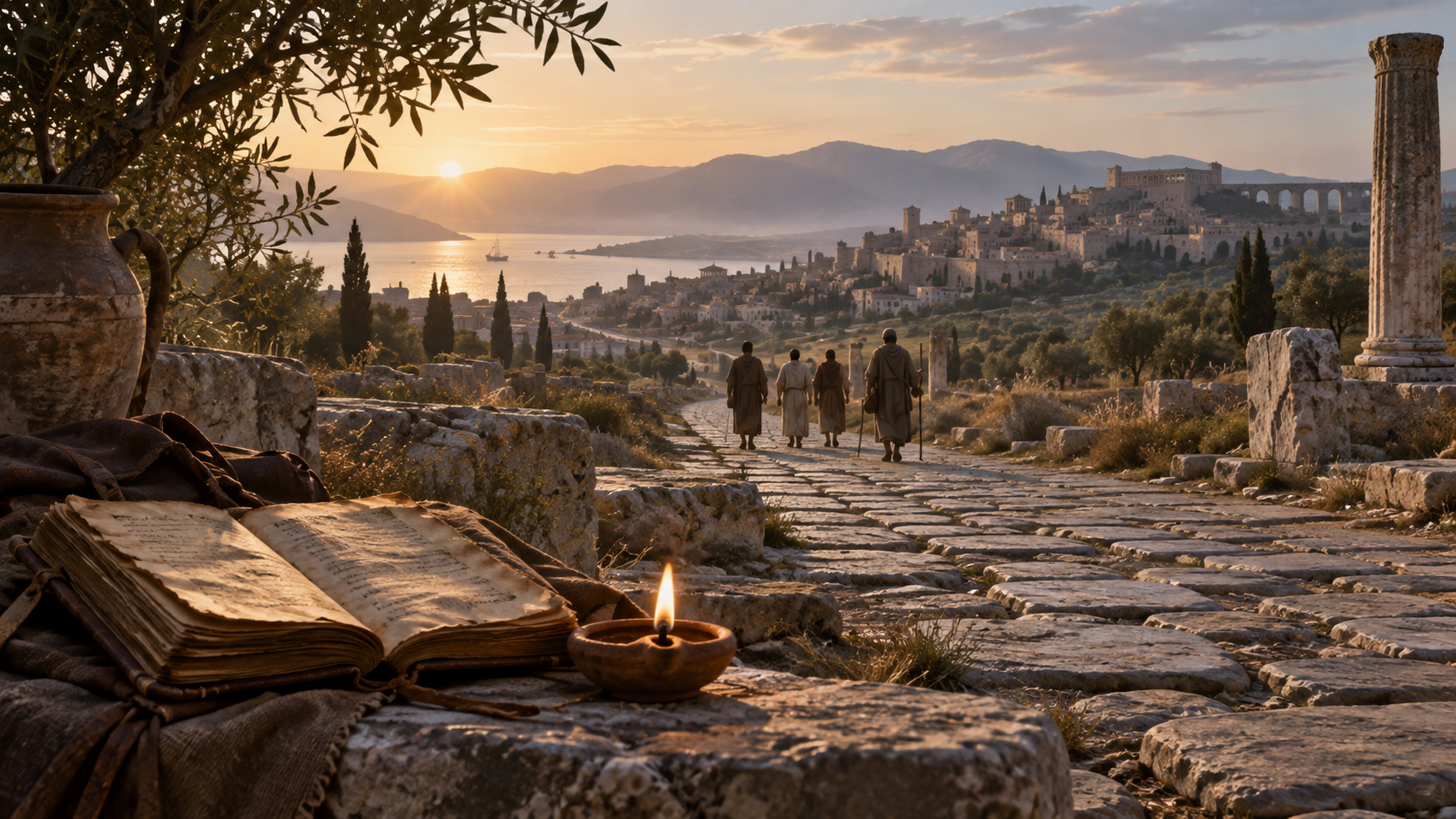
Paralelo
Nota: Esta publicación está basada en una conferencia de David Pawson de la serie Historia de la Iglesia (Parte 1: 30–400 d. C.), de aproximadamente 58 minutos de duración. Todos los argumentos principales provienen directamente de Pawson. Siempre que investigué algo, lo comparé con las fuentes históricas o corregí un pequeño detalle, lo dejé como una nota al margen ámbar entretejida directamente en el texto, de la misma manera que anotarías en el margen de un libro que estás leyendo.
La historia más asombrosa de la historia
la carta de Pablo a los Romanos: "Por toda la tierra ha salido su voz, y hasta los confines del mundo sus palabras".
David Pawson comienza con una pregunta simple pero sorprendente: ¿Cómo se extendió el cristianismo desde un puñado de pescadores en el 30 d.C. hasta el mundo entonces conocido en el 400 d.C., reemplazando a todas las demás religiones a lo largo del camino?
Lo hicieron sin un ejército. Sin dinero. Sin gente influyente. Y lo hicieron contra todo el poder del Imperio romano.
¿Y quiénes eran? Pawson enfatiza el punto: en su mayoría, don nadie. Pablo escribió a la Iglesia de Corinto: "Miraos a vosotros mismos: no muchos sabios, no muchos poderosos, no muchos de noble cuna". La Iglesia primitiva estaba compuesta en gran medida por esclavos y por los estratos más bajos de la sociedad y, sin embargo, fueron esas personas las que conquistaron un imperio.
Ésta es la historia más asombrosa de la historia de la humanidad.
El punto de partida: el final de Hechos (60 d. C.)
El Libro de los Hechos cubre los primeros 30 años de la historia de la Iglesia: del 30 d.C. al 60 d.C. Es una historia inacabada: desde Jerusalén, la capital del mundo sagrado, hasta Roma, la capital del mundo secular.
Pero la historia siguió extendiéndose en ondas.
Pawson resume las ventajas que tuvo la Iglesia primitiva:
Calzadas romanas. Carreteras rectas que recorren el mundo mediterráneo, permitiendo a los apóstoles y comerciantes viajar sin pasaportes ni visados.
Lengua griega común. Todo el imperio hablaba un idioma: el evangelio podía predicarse en una sola lengua.
Pax Romana. Durante la paz romana, la gente podía viajar de un país a otro sin temor a la guerra.
Comunidades judías. En la mayoría de las ciudades grandes, grupos de judíos ya conocían el Antiguo Testamento y estaban dispuestos a escucharlo.
Un imperio moral y espiritualmente enfermo. La gente tenía hambre de algo real.
Y, sin embargo, Pawson dice: incluso con estas ventajas, fue un triunfo sorprendente.
No tenían edificios. Ninguna organización denominacional. Sin sede. Sin recursos económicos. Sin comités. Y aun así lo hicieron.
La organización de la Iglesia primitiva. Era totalmente sencilla: grupos locales llamados iglesias, cada uno con ancianos para el liderazgo espiritual y diáconos para el servicio práctico. Entre las iglesias se movían apóstoles, que plantaban otras nuevas; evangelistas, que predicaban el evangelio; y profetas, que traían la palabra de Dios. Ésa es la única organización que encontramos en el Nuevo Testamento.
Su adoración. Bautismo por inmersión. Pan y vino en la Cena del Señor. Una mezcla de oraciones fijas y oración libre. Cantar, sin instrumentos ni coros, pero les encantaba cantar.
Mapa de la Iglesia primitiva
De Jerusalén a los confines del Imperio romano (30–400 d. C.)
Los puntos usan la longitud y latitud relativas de las ciudades; las líneas finas desde Jerusalén muestran la dirección de la expansión, no rutas literales de viaje.
Este es un diagrama de coordenadas relativas, no un mapa de costas ni de fronteras antiguas. La longitud y la latitud mantienen coherentes las relaciones este–oeste y norte–sur; la lista estática inferior aporta el detalle histórico sin depender de pasar el cursor.
Tres batallas
El marco analítico central de Pawson: en los primeros cuatro siglos, la Iglesia tuvo que luchar en tres grandes batallas —y ganó cada una.
La primera batalla — espiritual, comenzando con los judíos. La segunda batalla — mental, comenzando con los griegos. La tercera batalla — física, comenzando con los romanos.
Pawson dice: *Estamos librando las mismas tres batallas hoy. Por eso enseña historia, porque esto no es el pasado. Es el presente.
Tres batallas, 30–400 d. C.
Tres batallas que la Iglesia primitiva libró y ganó
Tres presiones distintas, tres respuestas distintas y una historia de una comunidad que perseveró sin ejército.
- 30–400+ d. C.
Batalla espiritual
Presión
Herejía e intentos de mezclar el cristianismo con otras religiones.
Respuesta
La Iglesia se mantuvo en la confesión de que Jesús es el camino único de salvación.
Resultado duradero
Una identidad cristiana distinta y sin concesiones.
- 50–325 d. C.
Batalla intelectual
Presión
Gnosticismo, marcionismo, arrianismo y filosofías que redefinían la fe.
Respuesta
Los dirigentes interpretaron las Escrituras y formaron el canon y los credos.
Resultado duradero
La fe se aclaró mediante el Credo y el Concilio de Nicea.
- 64–312 d. C.
Batalla física
Presión
Persecución romana, desde Nerón hasta Diocleciano.
Respuesta
Las comunidades perseveraron; algunas sufrieron el martirio, mientras otras capitularon o huyeron.
Resultado duradero
La persecución terminó después de Constantino; la Iglesia permaneció.
Puntos de orientación seleccionados
Los paneles de colores distinguen tres clases de presión; las etiquetas y el orden de lectura transmiten el significado sin depender del color. Los puntos dorados son marcadores de orientación, no una serie temporal continua.
Primera batalla: espiritual: contra el sincretismo
Existe una idea popular –entonces y ahora– de que el cristianismo debe mezclarse con otras religiones. Que todas las religiones son básicamente iguales. Que todos estamos viajando hacia el mismo Dios por caminos diferentes.
Pawson cuenta que recogió a un autoestopista, un estudiante que se entrenaba para enseñar conocimientos religiosos. El joven no creía en Dios, pero su objetivo era mostrar a los niños que todas las religiones son fundamentalmente iguales.
Ésta es la batalla espiritual que enfrentó la Iglesia primitiva.
El primer mártir: Esteban
La primera persona que dio su vida por Jesús fue Esteban, y murió por esta única cosa: declarar que el cristianismo nunca se mezclaría con el judaísmo, que el judaísmo había quedado atrás y que el cristianismo era único y no podía diluirse.
Los judíos estaban tan enojados que lo arrastraron fuera de las murallas de la ciudad y lo apedrearon hasta matarlo.
El mismo Jesús sabía que los dos no se mezclarían. Pawson recuerda su enseñanza: hacerlo es como verter vino nuevo en odres viejos, o coser un trozo de tela sin encoger sobre una prenda vieja —tarde o temprano se tensa y se rasga—. Los dos no se pueden mezclar.
Pero la batalla no terminó con Esteban. Pablo se vio envuelto en la controversia y Pedro fue arrastrado contra su voluntad: Pedro, judío hasta la punta de los dedos, no tenía tiempo para los gentiles hasta que Dios tuvo que enseñarle lo contrario. Cuando el templo de Jerusalén fue destruido por los ejércitos romanos en el 70 d. C., la gente podría haber pensado que ése era el fin del judaísmo. Pero no fue así.
Durante trescientos años más, varias sectas siguieron intentando arrastrar a los cristianos de nuevo bajo la ley judía. Pawson las nombra: los nazarenos y los ebionitas, que insistían en que los gentiles conversos aún debían observar la ley mosaica y el sábado. Persistieron durante tres siglos completos.
"La gente que lo hace hoy", Pawson observa, "son los adventistas del séptimo día, muchos de ellos buenos cristianos, pero están tratando de traernos nuevamente bajo la ley del sábado del séptimo día".
Finalmente se ganó la batalla: el cristianismo era único, puro, independiente del judaísmo.
El Panteón y el pecado del sincretismo
A medida que el Imperio Romano se expandió, construyeron el Panteón, literalmente "la casa de todos los dioses" (pan = todos, theon = dioses). Cada vez que aparecía una nueva religión, se colocaba en un nicho una estatua de su deidad.
Los romanos invitaron a los cristianos a colocar una estatua de Jesús en uno de esos nichos.
Los cristianos se negaron rotundamente.
Pawson observa: cuando visitó el Panteón, todos los nichos estaban vacíos, pero había una estatua de Jesús, porque el edificio finalmente pasó a manos de la Iglesia y ésta lo convirtió en un lugar de culto. Eso fue una victoria, no un compromiso.
Esta política se llama sincretismo — la mezcla de religiones. Esta fue la batalla que la Iglesia tuvo que librar.
"Religio Licita": religión legal
El Imperio romano tenía un sistema de registro de religiones. Si te registrabas, tu religión se convertía en religio licita —una religión legal reconocida por el Estado—.
Los cristianos se negaron a registrarse. Dijeron: "no somos una religión; somos seguidores de Jesucristo".
Esto hizo que sus vidas fueran considerablemente más peligrosas.
Cuando César se convirtió en Dios
Poco a poco, todas las religiones encontraron sus nichos en el Panteón y, finalmente, colocaron una estatua de César allí. César se convirtió en dios. Y el Imperio Romano declaró: de ahora en adelante, nuestra religión es el culto al César. Quema incienso al César. Di "César es el Señor".
Fue entonces cuando comenzó la batalla física.
Pero hay una interesante doble acusación de ateísmo: los romanos llamaban ateos a los cristianos porque se negaban a adorar a los dioses romanos. Y los cristianos llamaban ateos a los romanos porque, a pesar de todos sus dioses, no tenían al Dios verdadero. La palabra "ateo" aparece una vez en la Biblia: en la carta de Pablo a los Efesios, donde Pablo les dice a los gentiles que estaban "sin Dios en el mundo".
Por eso Pablo en Atenas dijo a los atenienses: "He visto todos vuestros altares, pero observé uno con la inscripción: Al Dios Desconocido. He venido a hablaros de ese Dios, el único Dios que no conocéis". Ateos, todos ellos.
Segunda batalla: mental - contra la filosofía
Ésta fue la batalla más difícil porque sucedió dentro de la Iglesia, no fuera de ella.
Los griegos eran pensadores brillantes: intelectuales, eruditos. Y cuando el cristianismo se encontró con el mundo intelectual, el mayor peligro fue que los intelectuales alteraran el cristianismo y produjeran lo que, según ellos, era una forma superior del mismo, comprometiendo la verdad para adaptarla al intelecto.
Pawson dice: "Hay muchas preguntas que tengo con mi intelecto y que aún no he recibido respuesta. Pero gracias a Dios llegué al punto en que estaba preparado para creer antes de tener mi intelecto completamente satisfecho".
Esta batalla tuvo que librarse con palabras y plumas, y algunos de los mejores escritos de la historia de la Iglesia provienen de ella. Ireneo escribió cinco libros bajo el título Contra las herejías —una refutación sistemática de cada rama del pensamiento gnóstico—. Orígenes de Alejandría produjo unos sorprendentes 6.000 libros, cartas y folletos en defensa de la fe. El arsenal intelectual de la Iglesia primitiva era formidable.
La batalla con Marción
Marción fue el primero en llevar las tijeras a la Biblia. No le gustaba el Dios de la ira del Antiguo Testamento y concluyó que el Dios del Antiguo Testamento era un Dios diferente del Dios del Nuevo Testamento.
Su solución: eliminar todo el Antiguo Testamento.
Pero luego descubrió que necesitaba recortar más. El Apocalipsis se parecía demasiado al Antiguo Testamento... fuera. Pablo dijo algunas cosas incómodas: fuera. Incluso los Evangelios tenían pasajes que no le gustaban.
Pawson señala: "Fue el primero en descubrir que cuando aplicas las tijeras a la Biblia, no puedes parar".
Terminó con dos dioses – uno para el Antiguo Testamento, otro para el Nuevo.
Ésa es una herejía contra la que todavía estamos luchando hoy.
La batalla contra el gnosticismo
Esta fue una batalla mucho más grande. El gnosticismo surgió de una mezcla de pensamiento (egipcio, persa, posiblemente indio) con una filosofía básica:
Las cosas espirituales son buenas. Las cosas materiales son malas.
Esto llevó a una cadena de conclusiones perjudiciales:
- Si la materia es mala → Dios no podría haberla creado.
- Si la materia es mala → Jesús no pudo haber tenido un cuerpo físico.
- Por lo tanto → Jesús sólo apareció tener un cuerpo. Era un fantasma.
- Por lo tanto → Él realmente no murió. Nunca tuvo hambre ni se cansó.
- Por tanto → La resurrección del cuerpo es absurda.
Pawson explica: "Por eso Juan escribió su Evangelio y su Primera Epístola: estaba luchando contra este pensamiento dentro de la Iglesia".
La apertura de 1 Juan: "Lo que hemos oído, lo que hemos visto con nuestros ojos, lo que hemos mirado y nuestras manos tocaron, esto proclamamos acerca de la Palabra de vida..." — eso es el combate contra el gnosticismo.
Las mentes más grandes de la Iglesia se opusieron a ello: Tertuliano de Cartago en el norte de África, Clemente y Orígenes de Alejandría y Cipriano — todos escribieron para refutar este pensamiento.
Tres logros de la batalla mental
La Iglesia hizo tres cosas para ganar esta batalla:
1. El Canon del Nuevo Testamento. Con tantos evangelios falsos circulando, la Iglesia necesitaba identificar lo que era real. Recopilaron todos los libros que genuinamente se remontaban a los apóstoles, aquellos que recibieron la verdad directamente de Jesús. Hacia el año 200 d. C., el Nuevo Testamento había sido compilado. Tenemos el Nuevo Testamento hoy debido a esa batalla.
2. Los Credos. Para expresar claramente la fe, la Iglesia comenzó a hacer listas: credos (de credo = "Creo"). El Credo de los Apóstoles es una respuesta directa al gnosticismo:
- "Creo en Dios Padre Todopoderoso, Hacedor del cielo y de la tierra" - Dios creó realmente el mundo material.
- "Jesús... padeció bajo el poder de Poncio Pilato, fue crucificado, muerto y sepultado" — Él tenía un cuerpo real.
- "Creo en la resurrección del cuerpo" — el cuerpo es bien.
3. Concilios. No para organizar la Iglesia, sino para compartir la batalla y cerrar filas por la fe.
La batalla contra el arrianismo: ¿Es Jesús plenamente Dios?
Cuando Constantino se convirtió al cristianismo en el 312 d. C., descubrió que la Iglesia se encontraba en un terrible estado de discusión. La causa: un predicador alto, apuesto y brillantemente dotado de Alejandría llamado Arrio estaba enseñando una doctrina semejante a la que los testigos de Jehová enseñan hoy: que Jesucristo no es plenamente Dios.
Arrio dijo: Jesús es el "Hijo de Dios", pero no Dios mismo. Fue creado, no engendrado. Es semejante a Dios, pero no es Dios.
Esto se extendió por la Iglesia como una locura, como una tendencia de moda femenina: casi todo el imperio siguió a Arrio.
Sólo una persona vio lo que estaba pasando y se atrevió a oponerse a ello.
Su nombre era Atanasio. Era un diácono joven, físicamente pequeño; algunos lo llamaban enano. Arrio era un obispo alto e imponente con miles de admiradores. Atanasio dijo: "Eso está mal. Y lo combatiré".
Nació el proverbio latino: Atanasio contra mundum — "Atanasio contra el mundo".
Durante su vida fue exiliado cinco veces por cuatro emperadores diferentes. Él nunca se rindió.
Ochenta y seis años le he servido y Él nunca me ha hecho mal. ¿Cómo entonces puedo blasfemar contra mi Rey a quien sirvo? — Policarpo (c. 155 d.C.)
La cascada gnóstica
Una premisa falsa deshace toda la fe
Pawson muestra cómo el gnosticismo comenzó con una idea equivocada y luego, como fichas de dominó al caer, negó sucesivamente cada pilar de la fe cristiana.
La materia es mala; el espíritu es bueno
La premisa falsa
→ Dios no pudo haber creado la materia
Niega al Creador
→ Jesús no pudo haber tenido un cuerpo real
Niega la encarnación
→ Solo era un fantasma: nunca tuvo hambre ni se cansó
Niega su humanidad
→ En realidad no murió en la cruz
Niega la cruz
→ La resurrección del cuerpo es absurda
Niega la resurrección
La respuesta de la Iglesia
«El Verbo se hizo carne y habitó entre nosotros». — el Evangelio según Juan. Juan escribió su Evangelio y sus epístolas precisamente para detener esta cascada desde su primer paso.
Concilio de Nicea — 325 d. C.
Una letra que cambió para siempre la teología de la Iglesia
Arrio enseñaba
ὁμοιούσιος
homoiousios
«de sustancia semejante»: Jesús es como Dios, pero no es Dios. Fue creado, no engendrado eternamente.
Implicación:
Si Jesús no es plenamente Dios, no puede tender un puente verdadero entre Dios y la humanidad: toda la fe se derrumba.
Atanasio defendía
ὁμοούσιος
homoousios
«de la misma sustancia»: Jesús ES Dios. No es simplemente como Dios, sino uno en ser con el Padre.
Base bíblica:
«En el principio era el Verbo... y el Verbo era Dios». — el Evangelio según Juan
La diferencia: una letra, la iota (ι)
Una letra, la iota, separa «Jesús es semejante a Dios» de «Jesús ES Dios». Por eso Pawson observa: «A la gente le pareció extraño dividir la Iglesia por una palabra, pero era una palabra muy importante».
Atanasio: contra el mundo
Mientras el arrianismo barría el imperio como una moda, Atanasio —un diácono joven y físicamente pequeño— se mantuvo solo. Cuatro emperadores lo exiliaron cinco veces. Proverbio latino: Athanasius contra mundum — «Atanasio contra el mundo». Al final, venció.
Credo niceno (325 d. C.): «...un solo Señor Jesucristo, Hijo unigénito de Dios, engendrado del Padre antes de todos los mundos, Dios de Dios, Luz de Luz, Dios verdadero de Dios verdadero, engendrado, no creado, de la misma sustancia que el Padre...»
El Concilio de Nicea (325 d. C.)
Constantino convocó a unos 300 obispos de todo el Imperio; como Constantinopla todavía no existía, se reunieron en una ciudad llamada Nicea (actual İznik, Turquía), cerca de Nicomedia.
Los obispos entraron al salón con las marcas de la persecución en sus cuerpos; en palabras de Pawson, "Entraron los mancos y los cojos". La batalla física acababa de terminar y sus veteranos estaban sentados en la sala para librar la batalla mental.
Atanasio, todavía diácono y demasiado joven para ser admitido en el debate principal, se sentó afuera. Pero él era la figura central de la discusión. Continuamente pasaba argumentos a través de un amigo: el amigo entró corriendo, presentó el punto de Atanasio y luego salió corriendo para transmitir la respuesta de Arrio para que Atanasio pudiera contrarrestarla.
El debate se encendió en torno a dos palabras:
- ὁμοούσιος (homoousios): Jesús es "de la misma sustancia" que el Padre - Jesús es Dios.
- ὁμοιούσιος (homoiousios): Jesús es "de sustancia similar" - Jesús es como Dios.
La diferencia: una letra ι (iota). Pero era la diferencia entre la fe y la herejía.
Atanasio prevaleció. El Concilio de Nicea produjo el Credo Niceno:
"Creo en un solo Señor Jesucristo... Dios de Dios, Luz de Luz, Dios verdadero de Dios verdadero, engendrado, no creado, siendo de una sola sustancia con el Padre..."
Y cada Navidad todavía lo cantamos: "¡Escuchen! Los ángeles heraldos cantan: Dios de Dios, Luz de Luz eterna..." Cantamos el resultado del Concilio de Nicea.
Tercera batalla: física: contra la persecución romana
En los primeros cuatro siglos, la Iglesia nunca usó la fuerza física para establecer el evangelio. La Inquisición llegaría mucho más tarde. La única fuerza que utilizó fue el amor.
Pero la fuerza física sí se utilizó contra ellos, una y otra vez.
¿Por qué sufrieron tanto los cristianos?
La gente culpaba a los rumores: que los cristianos eran caníbales (un malentendido de la Cena del Señor), que celebraban "fiestas de amor" obscenas, que se negaban a participar en costumbres sociales normales, que eran una sociedad secreta que amenazaba la seguridad imperial.
Pero Pawson dice: esa no fue la verdadera razón.
La verdadera razón son las palabras del mismo Jesús: "Me han odiado sin causa." Hay un odio irracional en lo más profundo del corazón humano hacia Dios y, por tanto, hacia su pueblo.
Pawson va más allá, y esto necesita contexto: sostiene que "la otra cara del antisemitismo es la actitud de los judíos hacia los cristianos" y que "fueron los judíos quienes primero causaron el sufrimiento de los cristianos, una y otra vez". (Nota: así es como Pawson lo formuló en la década de 1960. Hechos registra la oposición temprana de algunos líderes judíos, pero los historiadores modernos son cautelosos ante tal atribución colectiva: la gran mayoría de las persecuciones posteriores provinieron del Estado romano, no de las comunidades judías.)
Nerón y el comienzo de la persecución (64 d. C.)
Un día, Pawson se encontraba en las ruinas de los jardines del palacio de Nerón en Roma, sabiendo que el suelo estaba empapado de sangre.
El loco emperador Nerón, en su ambición de reconstruir Roma como una gran metrópoli, supuestamente prendió fuego a la ciudad. Catorce de diecisiete distritos fueron arrasados. Cientos murieron. Cuando la culpa empezó a recaer sobre Nerón, buscó un chivo expiatorio: "Los cristianos lo hicieron".
Arrestó a todos los cristianos que pudo encontrar en Roma. Los envolvió en pieles de fieras y les soltó sus perros. Los decapitó. Los crucificó. Y finalmente, los cubrió con brea, los metió vivos en barriles y los encendió como antorchas humanas en su jardín mientras conducía su carro como loco en la oscuridad.
Ese fue el comienzo. Y desde entonces hasta el 300 d.C., la Iglesia soportó diez períodos de persecución, los más espantosos que jamás haya conocido.
Pawson sostiene un libro viejo que compró de segunda mano: El libro de los mártires de Foxe, alguna vez lectura dominical obligatoria para los cristianos. Señala que muestra que, hasta el momento en que fue escrito, nunca había habido un período de diez años sin que los cristianos sufrieran el martirio. "Y todavía no lo hay".
El apóstol Juan en Patmos
Alrededor del 95 d.C., el emperador Domiciano exilió a Juan, el último de los doce apóstoles, a las minas de sal y luego a la pequeña isla de Patmos en el mar Egeo, donde fue encadenado al muro de una prisión.
De esa celda de la prisión salió el Libro del Apocalipsis, tal como Bunyan escribiría más tarde El progreso del peregrino en la cárcel de Bedford.
Pawson cita a Pablo: "Puede que esté encadenado, pero la palabra de Dios no está atada".
Plinio y Trajano (c. 110 d.C.)
Alrededor del 110 d.C., el nuevo gobernador Plinio llegó a Bitinia en Asia Menor. Quedó asombrado: los templos paganos estaban desiertos, los santuarios idólatras ya no servían para nada. Preguntó por qué.
"Los cristianos, señor. Son demasiados".
Plinio comenzó a arrestar y ejecutar a cristianos. Pero estaba desconcertado, tanto por su número cada vez mayor como por la calidad de sus vidas. Finalmente envió un espía a uno de sus servicios matutinos.
El espía regresó con su informe: "Se reúnen antes del amanecer. Cantan himnos a Cristo como Dios. Luego hacen un juramento, un sacramentum, de no robar, no cometer adulterio, no asesinar".
Plinio quedó tan desconcertado que escribió al emperador Trajano. La respuesta de Trajano: no acepte acusaciones anónimas, pero si se confirma que alguien tiene una religión antirromana, compruebe si dirá "César es el Señor". Si no lo dice, ejecútelo.
Ignacio de Antioquía
Ignacio era obispo de Antioquía; Pawson lo llama "uno de los ministros más jóvenes de la Iglesia en aquellos días". Fue arrestado y escoltado desde Antioquía a Roma para ser arrojado a las fieras en el Coliseo.
Su viaje fue un espectáculo de triunfo. A lo largo del camino, los cristianos abandonaron sus hogares y caminaron con él por tramos, compartiendo comunión con el hombre que caminaba hacia la muerte.
Pawson lee una de las cartas del propio Ignacio: "Ahora comienzo a ser discípulo. El que está cerca de la espada, cerca de Dios está. El que está entre las fieras, está en compañía de Dios".
Ignacio escribió cartas inolvidables todas las noches mientras descansaba, encadenado a su soldado romano. Le escribió a Policarpo, el obispo de Esmirna: "Mantente firme, firme como un yunque, aunque te golpeen a menudo".
Cuarenta años después, Policarpo fue martirizado.
Policarpo en Esmirna (c. 155 d.C.)
Los juegos romanos se celebraban en Esmirna en honor al emperador. La multitud se emocionó. La sangre comenzó a fluir. Entonces alguien gritó: "¡Fuera los ateos!" – y once cristianos fueron arrastrados a la arena, llamados ateos y arrojados a los leones. Entonces la multitud llamó a Policarpo.
Enviaron a un soldado para arrestarlo. Llegaron a una pequeña cabaña en las afueras de Esmirna. Llamaron. Policarpo se acercó a la puerta. No lo reconocieron y preguntaron: "¿Hay aquí un hombre llamado Policarpo?"
Podría haber dicho que no. Estuvo tentado a hacerlo. Pero el Señor le dio la victoria. Dijo: "Soy Policarpo" y extendió las muñecas para recibir las cadenas.
En la arena, el gobernador miró el cabello blanco del anciano y dijo: "Ten piedad de tu edad. Maldice a Cristo y podrás volver a tu cabaña".
Policarpo respondió:
"Ochenta y seis años le he servido, y él nunca me ha hecho mal. ¿Cómo, pues, puedo blasfemar contra mi Rey a quien sirvo?"
No pudieron hacer más que matarlo. Se habían llevado los leones, así que encendieron una hoguera y lo ataron a un palo. Pero el viento era fuerte y alejó las llamas de Policarpo, lo que impresionó profundamente a la multitud. Finalmente, un soldado romano, por compasión hacia el anciano, le clavó un puñal en el corazón.
Los cristianos registraron ese martirio y terminaron el relato con estas palabras: "...Quintus Statius Quadratus siendo cónsul, pero Jesucristo siendo Rey para siempre." El nombre de Quadratus queda registrado como ejecutor. El nombre de Jesucristo queda registrado como Rey.
Blandina en Lyon (177 d. C.)
La persecución se extendió a Francia. En Lyon, el anciano ministro Potino fue encarcelado y murió allí. Luego se llevaron a una joven esclava adolescente, su nombre era Blandina.
La torturaron desde la mañana hasta la noche. Sus verdugos se cansaron y reconocieron que estaban vencidos: no podían hacerle más.
Su consuelo y alivio en el dolor fue este grito repetido: "Soy cristiana, y no hay nada vil en lo que hacemos".
Al día siguiente, después de los azotes, de las fieras, de la silla al rojo vivo, la encerraron en una red y la arrojaron delante de un toro. El toro la arrojó. Y ella murió.
El historiador registra: "Ella, como una madre noble que había animado a sus hijos, corrió hacia ellos con alegría y júbilo, como si la invitaran a una fiesta de bodas".
Una mujer en una prisión del norte de África
Pawson cuenta otra historia del norte de África. Una mujer cristiana fue encarcelada. Su bebé estaba en la celda de al lado, hambriento y llorando. No se le permitió amamantar a su hijo. Sus torturadores hicieron la oferta: "Puedes alimentar a tu bebé tan pronto como digas que César es el Señor".
Ella se negó. Y esta fue su respuesta:
"Damos honor al César como César. Pero rendimos temor y adoración a Cristo como Señor".
Las persecuciones de Decio y Diocleciano
Después de aproximadamente 30 años de paz, bajo el emperador Decio (c. 249–251 d. C.), por primera vez Roma sistemáticamente intentó aplastar el cristianismo en todo el imperio, no sólo a nivel local.
Pawson dice que este fue un momento de dolor porque muchos cristianos cedieron. Algunos decían "César es el Señor". Algunos funcionarios fueron sobornados. Algunos huyeron. Esto creó un problema doloroso: cuando volvió la paz, aquellos que habían negado a Cristo querían volver a la Iglesia. ¿Qué se debía hacer? Esto casi partió a la Iglesia en dos.
Después de Decio vinieron 40 años de paz, y la Iglesia creció en número, riqueza e influencia.
Luego vino "la última aventura de Satanás", bajo Diocleciano (303 d. C.): ordenó que todas las iglesias fueran destruidas, cada Biblia fuera quemada, todo cristiano que ocupara un cargo romano fuera despedido y todo cristiano fuera decapitado, quemado o ahogado.
Pawson señala: "Satanás sabía que estaba perdiendo. Había demasiados cristianos ahora. El Imperio estaba siendo invadido. Y ésta era la batalla final".
Diez persecuciones romanas
64–311 d. C.: de Nerón a Diocleciano
Estos diez marcadores orientan la historia; no son una medida continua de la intensidad de la persecución en todo el imperio.
- Nerón64–68 d. C.Intensidad relativa
Culpó a los cristianos del incendio de Roma; fue más feroz en la propia ciudad.
- Domiciano81–96 d. C.Intensidad relativa
La tradición sitúa a Juan exiliado en Patmos; la persecución siguió siendo local.
- Trajano98–117 d. C.Intensidad relativa
Ignacio fue martirizado; la carta de Plinio muestra una política local desigual.
- Adriano117–138 d. C.Intensidad relativa
Más moderada, aunque continuó el hostigamiento local.
- Marco Aurelio161–180 d. C.Intensidad relativa
La persecución de Lyon tuvo lugar en 177 d. C.; Blandina fue martirizada.
- Septimio Severo202–211 d. C.Intensidad relativa
Prohibió la conversión al cristianismo; hubo persecución en África y Egipto.
- Maximino el Tracio235–238 d. C.Intensidad relativa
Se dirigió específicamente contra los dirigentes de la Iglesia.
- Decio249–251 d. C.Intensidad relativa
La primera persecución sistemática en todo el imperio; muchos cristianos apostataron.
- Valeriano257–260 d. C.Intensidad relativa
Se dirigió contra obispos, clero y cristianos de las clases altas.
- Diocleciano303–311 d. C.Intensidad relativa
La Gran Persecución: iglesias destruidas, Biblias quemadas y ejecuciones masivas.
La lista de diez persecuciones es un marco tradicional; las celdas de intensidad son una codificación relativa de las descripciones del artículo, no datos cuantitativos ni una afirmación de que todos los lugares sufrieran por igual.
Victoria: Constantino y el Puente Milvio (312 d. C.)
312. Constantino estaba a punto de marchar contra los enemigos de Roma. Y en ese momento (Pawson dice honestamente que no puede separar la verdad de la ficción en lo que nos ha llegado), Constantino tuvo una visión en el cielo. Vio una cruz y oyó una voz: "In hoc signo vinces" — "En este signo, conquista".
Pintó la cruz en el escudo de cada soldado romano. Y declaró: "De ahora en adelante soy cristiano. Y tú también".
Pawson no está seguro de que esto haya sido algo del todo bueno. Pero el emperador se había hecho cristiano.
Y Constantino declaró:
- El domingo sería día de descanso (por primera vez en la historia)
- Las mujeres serían valoradas más en el Imperio
- Los esclavos serían tratados adecuadamente
Ese fue el fin de la batalla física en el Imperio Romano. Las persecuciones cesaron.
Pero las batallas espirituales y mentales aún no estaban ganadas del todo.
Julián, pariente de Constantino, y el intento de avivamiento pagano
Pawson dice: "Constantino tenía dos parientes jóvenes, uno llamado Julián". Ellos declararon: "No nos gusta lo que hizo. Vamos a restaurar los dioses paganos romanos".
Reabrieron los templos paganos.
Nadie vino.
Ya era demasiado tarde. La batalla espiritual había sido ganada. Para el año 400 d. C., sólo una religión era prominente en todo el Imperio romano.
La expansión por el imperio
Para el 400 d.C., el cristianismo había alcanzado:
- Gran Bretaña: San Albano, el primer mártir de Gran Bretaña; según la tradición posterior, un soldado romano que murió por Jesús. Todavía llamamos al lugar St. Albans.
- África: La Iglesia se extendió profundamente en África
- Siria y la India: La Iglesia se extendió hacia el este
- Todo el imperio romano: El mundo entonces conocido había escuchado el evangelio.
La batalla física estaba ganada. La batalla mental estaba ganada. La batalla espiritual fue ganada.
La Iglesia había capturado el mundo para Jesucristo hacia el 400 d.C.
Crecimiento durante la persecución
Porcentaje estimado de la población del Imperio romano que era cristiana
Tres puntos estimados muestran la escala del cambio; no están unidos por una curva suave porque no existe una serie de observaciones continua.
≈1.000 creyentes
Un punto de partida muy pequeño
≈6 millones de personas
Estimación antes del giro de Constantino
≈33 millones de personas
Estimación por encima de la mitad del imperio
La idea es una paradoja de escala: la persecución no detuvo la expansión. Las cifras siguen siendo estimaciones.
Las estimaciones usan los puntos indicados en el ensayo de Rodney Stark, The Rise of Christianity (1996): unos 1.000 (40 d. C.), 6 millones/~10 % (300 d. C.) y 33 millones/más de la mitad (350 d. C.). No se dibuja una línea de interpolación; los intervalos no son datos faltantes.
¿Qué hizo que la Iglesia creciera bajo el sufrimiento?
Pawson hace dos observaciones importantes sobre todas esas persecuciones.
Primera observación: la dolorosa verdad: Si bien conocemos los nombres de muchos mártires, también sabemos que miles de cristianos cedieron bajo persecución. Algunos decían "César es el Señor". Algunos funcionarios fueron sobornados. Algunos huyeron. Ésta es la dolorosa verdad. Y cuando llegó la paz, quisieron regresar a la Iglesia, lo que casi partió en dos a la comunidad cristiana.
Segunda observación: la gran paradoja: La Iglesia nunca creció con tanta fuerza ni tan rápidamente como bajo esos sufrimientos.
Tertuliano, el cristiano norteafricano, dijo las inmortales palabras: "La sangre de los mártires es la semilla de la Iglesia."
Si quieres plantar una iglesia, planta un mártir. Eso es lo que dijo Tertuliano.
Y ésta es la respuesta dolorosa pero real a por qué la Iglesia sufrió: porque la persecución tamizó la membresía. Redujo a los hombres de Gedeón a 300, los que podían mantenerse firmes. Hizo de la Iglesia lo que debería ser: un ejército noble.
Pawson concluye: la respuesta al sufrimiento no es algo que pueda entender completamente. Pero es verdad: donde una Iglesia sufre, crece.
Al este del telón de acero está la batalla física. Al oeste del telón de acero –aquí en Inglaterra, aquí donde estamos– está la batalla mental. Y es más difícil. —David Pawson
Tres batallas de un vistazo
Batalla espiritual
30–400+ d. C.Oponente: Judaísmo + religiones paganas
Pregunta central: ¿Puede el cristianismo mezclarse con otras religiones?
Campeones: Esteban, Pablo, Pedro
«No hay otro nombre bajo el cielo... por el cual debamos ser salvos». (los Hechos de los Apóstoles)
✓ Ganada: la identidad única y sin concesiones del cristianismo
Batalla intelectual
50–325 d. C.Oponente: Intelectuales griegos: gnosticismo, marcionismo, arrianismo
Pregunta central: ¿Puede la filosofía redefinir el cristianismo?
Campeones: Ireneo, Tertuliano, Orígenes, Atanasio
«Dios verdadero de Dios verdadero, engendrado, no creado...» (Credo niceno)
✓ Ganada: se formó el canon del NT, se establecieron los credos y se celebró el Concilio de Nicea
Batalla física
64–312 d. C.Oponente: El Imperio romano: diez oleadas de persecución
Pregunta central: ¿Puede la fuerza física exterminar a la Iglesia?
Campeones: Ignacio, Policarpo, Blandina y un número incontable de mártires
«Lo vencieron por la sangre del Cordero y por la palabra de su testimonio». (el Apocalipsis)
✓ Ganada: Constantino, 312 d. C.; terminaron las persecuciones
Estamos librando las mismas batallas hoy
Por eso Pawson enseña historia.
La batalla espiritual hoy: Apenas unas semanas antes de que se diera esta conferencia (década de 1960), en la iglesia más prominente de Cambridge, se llevó a cabo un servicio para el "Congreso Mundial de Religiones": budistas, hindúes, bahá'ís, judíos y cristianos, todos presentes para adorar juntos. Condición de participación: no se debe mencionar el nombre de Jesucristo.
Esa es la batalla que estamos librando.
La Biblia predice que habrá una religión mundial unificada, y aquellos que se nieguen a unirse no podrán comprar alimentos (el Apocalipsis).
La batalla mental hoy: La filosofía de nuestro tiempo no se llama gnosticismo, se llama existencialismo. La encuentras en la literatura de Jean-Paul Sartre, en la música de Debussy, en el arte de Picasso y en la cultura popular. La encuentras en la cultura de las drogas de los jóvenes. La encuentras en la declaración de Marshall McLuhan de que "el medio es el mensaje". Y en teología, se ve en personas como Bultmann y Tillich, popularizadas por personas como John Robinson (obispo de Woolwich) con su controvertido libro Honesto con Dios, y Howard Williams, entonces presidente de la Unión Bautista.
Se trata de personas que redefinen el cristianismo según una filosofía pagana, fundamentalmente atea, que hace a Dios impersonal o inexistente. "Dios ha muerto": esa frase es el resultado de que los teólogos cristianos sigan esta filosofía.
Pawson dice: la batalla mental necesita los mejores cerebros que podamos producir. Hay que combatirla con palabras y plumas. Y necesitamos el coraje de decir: "Esto no es la fe cristiana. Esto no es lo que creemos".
La batalla física hoy: Al este del Telón de Acero (esta conferencia se dio durante la Guerra Fría), la batalla física continúa, igual que en el primer siglo.
Pawson habla de Richard Wurmbrand, que había sido torturado en prisiones comunistas rumanas y estuvo presente en esta reunión, que se dirigía a Cambridge para confrontar a un clérigo que había sido anfitrión del servicio del "Congreso Mundial de Religiones" y había llamado homosexual a Jesús.
Martín Lutero, 450 años antes de esta conferencia, clavó sus tesis en la puerta de la iglesia. Pawson pregunta: "¿A dónde iríamos hoy para clavar cosas en las puertas de la iglesia?" Esta es la batalla mental. Está aquí. Está dentro de nuestras iglesias.
Pawson concluye:
"¿Por qué debería dejarse en manos de Wurmbrand, que ya ha librado la batalla física en el Este, librar ambas batallas? Ésta es la batalla que debemos librar. Y debemos decir muy claramente y con amor: esta es la fe. No la estamos alterando para los intelectuales de hoy. Este es el único evangelio que salva".
Tres batallas dejaron tres legados duraderos
Una identidad sin concesiones
La Iglesia mantuvo su confesión sobre Jesús bajo la presión de mezclar religiones.
Una fe expresada con claridad
Las Escrituras, el canon y los credos ayudaron a la Iglesia a responder a los desafíos intelectuales.
Una comunidad que perseveró
Las comunidades soportaron la persecución; después de Constantino terminó, pero la historia no.
El legado no es una imagen decorativa; es la manera en que la Iglesia conserva su identidad, articula su fe y vive bajo presión.
Note: This post is compiled from David Pawson's History of the Church lecture series (Part 1: AD 30–400), approximately 58 minutes long. All major arguments come directly from Pawson. Wherever I looked something up, checked it against the historical sources, or corrected a small detail, I've left it as an amber margin note woven right into the text — the way you'd jot in the margin of a book you're reading.
The most astonishing story in history
Paul’s letter to the Romans: "Their voice has gone out to all the earth, and their words to the ends of the world."
David Pawson opens with a simple but stunning question: How did Christianity spread from a handful of fishermen in AD 30, across the then-known world by AD 400, replacing every other religion along the way?
They did it without an army. Without money. Without influential people. And they did it against the full might of the Roman Empire.
And who were they? Pawson stresses the point: mostly nobodies. Paul wrote to the church at Corinth, "Look at yourselves — not many wise, not many powerful, not many of noble birth." The early Church was largely made up of slaves and the lowest ranks of society — and yet these were the people who won an empire.
Kit's note
Two small things I checked here. First — Paul's line in Paul’s first letter to the Corinthians: the Greek reads οὐ πολλοὶ δυνατοί (dunatoi = mighty, powerful), which is why ESV/NIV/KJV render it closer to "not many powerful" than "high calling." Second — the "60 million slaves" figure Pawson liked to cite comes from Edward Gibbon (1776) and is overstated; modern estimates put it at 5–10 million slaves out of a total population of ~60–70 million (10–15%). But whatever the number, his point holds: the Church began among society's lowest.
This is the most astonishing story in human history.
The Starting Point: End of Acts (AD 60)
The Book of Acts covers the first 30 years of Church history — AD 30 to AD 60. It's an unfinished story: from Jerusalem, the capital of the sacred world, to Rome, the capital of the secular world.
But the story kept spreading outward in ripples.
Pawson summarizes the advantages the early Church had:
Roman roads. Straight roads running around the Mediterranean world, allowing apostles and merchants to travel without passports or visas.
Common Greek language. The whole empire spoke one language — the gospel could be preached in one tongue.
Pax Romana. The Roman peace — people could travel from country to country without fear of war.
Jewish communities. In most large towns, groups of Jews already knew the Old Testament and were willing to listen.
A morally and spiritually sick empire. People were hungry for something real.
And yet Pawson says: even with these advantages, this was an astonishing triumph.They had no buildings. No denominational organizations. No headquarters. No financial resources. No committees. And yet they did it.
The organization of the early Church. Utterly simple: local groups called churches, each with elders for spiritual leadership and deacons for practical service. Between churches moved apostles who planted new ones, evangelists who preached the gospel, and prophets who brought the word of God. That is the only organization you find in the New Testament.
Their worship. Baptism by immersion. Bread and wine at the Lord's Supper. A mixture of fixed prayers and free prayer. Singing — no instruments, no choirs, but they loved to sing.
Early Church Map
From Jerusalem to the ends of the Roman Empire (AD 30–400)
Points use the cities' relative longitude and latitude; fine lines from Jerusalem show the direction of expansion, not literal travel routes.
This is a relative coordinate diagram, not a coastline or ancient-boundary map. Longitude and latitude keep the east–west and north–south relationships consistent; the static list below carries the historical detail without relying on hover.
Three Battles
Pawson's core analytical framework: in the first four centuries, the Church had to fight three great battles — and in each one, it won.
The first battle — Spiritual, beginning with the Jews. The second battle — Mental, beginning with the Greeks. The third battle — Physical, beginning with the Romans.
Pawson says: we are fighting the same three battles today. That is why he teaches history — because this is not the past. It is the present.
Three Battles AD 30–400
Three battles the early Church fought and won
Three different pressures, three different responses—and one story of a community that endured without an army.
- AD 30–400+
Spiritual battle
Pressure
Heresy and attempts to blend Christianity with other religions.
Response
The Church held to the confession that Jesus is the unique way of salvation.
Enduring result
A distinct, uncompromised Christian identity.
- AD 50–325
Mental battle
Pressure
Gnosticism, Marcionism, Arianism, and philosophies redefining the faith.
Response
Leaders interpreted Scripture and formed the canon and creeds.
Enduring result
The faith was clarified through the Creed and Council of Nicaea.
- AD 64–312
Physical battle
Pressure
Roman persecution, from Nero to Diocletian.
Response
Communities endured; some were martyred, while others capitulated or fled.
Enduring result
Persecution ended after Constantine; the Church remained.
Selected orientation points
The colored panels distinguish three kinds of pressure; labels and reading order carry the meaning without color. Gold points are orientation markers, not a continuous time series.
First Battle: Spiritual — Against Syncretism
There is a popular idea — then and now — that Christianity must be mixed with other religions. That all religions are basically the same. That we're all traveling to the same God by different roads.
Pawson tells of picking up a hitchhiker, a student training to teach religious knowledge. The young man didn't believe in God, but his goal was to show children that all religions are fundamentally the same.
This is the spiritual battle the early Church faced.
The first martyr: Stephen
The first person to give his life for Jesus was Stephen — and he died for this one thing: declaring that Christianity would never mix with Judaism. That Judaism had become obsolete. That Christianity was unique and could not be diluted.
The Jews were so angry they dragged him outside the city wall and stoned him to death.
Jesus himself knew the two would not mix. Pawson recalls his teaching: to do so is like pouring new wine into old wineskins, or sewing a patch of unshrunk cloth onto an old garment — sooner or later it pulls and tears away. The two cannot be blended.
But the battle didn't end with Stephen. Paul was drawn in, and Peter was flung into it against his will — Peter, a Jew to his fingertips who had no time for Gentiles until God had to teach him otherwise. When the Temple in Jerusalem was destroyed by the Roman armies in AD 70, people might have thought that was the end of Judaism. But it wasn't.
For three hundred more years, various sects kept trying to drag Christians back under the Jewish law. Pawson names them: the Nazarenes and the Ebionites — who insisted that Gentile converts must still observe the Mosaic law and the Sabbath. They persisted for three full centuries.
"The people doing it today," Pawson observes, "are the Seventh-day Adventists — good Christians, many of them, but they are trying to bring us back under the Sabbath law of the seventh day."
Finally the battle was won: Christianity was unique, unmixed, independent of Judaism.
The Pantheon and the sin of syncretism
As the Roman Empire expanded, they built the Pantheon — literally "the house of all gods" (pan = all, theon = gods). Every time a new religion appeared, a statue of its deity was placed in a niche.
The Romans invited Christians to place a statue of Jesus in one of those niches.
The Christians refused. Absolutely refused.
Pawson observes: when he visited the Pantheon, all the niches were empty — but there was a statue of Jesus, because the building was eventually taken over by the Church and turned into a place of worship. That was victory, not compromise.
Kit's note
One honest caveat: the detail about Romans "inviting" Christians to put a statue of Jesus in the Pantheon is a lovely story but appears in no primary source — the closest analogue is Eusebius (HE 2.2), where Emperor Tiberius proposes enrolling Christ among the gods and the Senate refuses, itself a legend. (The idea that the niches held the "seven planetary gods" is also just a modern hypothesis from Mommsen; the only ancient source, Cassius Dio 53.27.2, names only Mars and Venus.) But the core fact is real: the Pantheon really was taken over by the Church — consecrated as Santa Maria ad Martyres in AD 609. That victory genuinely happened.
This policy is called syncretism — the mixing of religions. This was the battle the Church had to fight.
"Religio Licita" — Legal Religion
The Roman Empire had a religion registration system. If you registered, your religion became religio licita — a legal faith recognized by the state.
Christians refused to register. They said: We are not a religion. We are followers of Jesus Christ.
This made their lives considerably more dangerous.
When Caesar Became God
Gradually, all the religions found their niches in the Pantheon — and finally, they placed a statue of Caesar there. Caesar became a god. And the Roman Empire declared: from now on, our religion is the worship of Caesar. Burn incense to Caesar. Say "Caesar is Lord."
That is when the physical battle began.
But there is an interesting double charge of atheism: the Romans called Christians atheists because they refused to worship the Roman gods. And Christians called the Romans atheists — because despite all their gods, they had no God. The word "atheist" appears once in the Bible — in Paul’s letter to the Ephesians, where Paul tells the Gentiles they were "without God in the world."
That is why Paul at Athens said to the Athenians: "I have seen all your altars — but I noticed one inscribed: To The Unknown God. I have come to tell you about that God — the one God you do not know." Atheists, every one of them.
Second Battle: Mental — Against Philosophy
This was the harder battle because it happened inside the Church, not outside it.
The Greeks were the brilliant thinkers. The intellectuals. The know-alls. And when Christianity encountered the intellectual world, the greatest danger was that intellectuals would alter Christianity — producing what they claimed was a superior form of it, compromising truth to fit the intellect.
Pawson says: "There are many questions that I have with my intellect that I still haven't got answered. But thank God I got to the point where I was prepared to believe before I got my intellect entirely satisfied."
This battle had to be fought with words and pens — and some of the finest writings in Church history come from it. Irenaeus wrote five books under the title Against Heresies — a systematic refutation of every branch of Gnostic thought. Origen of Alexandria produced an astonishing 6,000 books, letters, and pamphlets in defence of the faith. The intellectual arsenal of the early Church was formidable.
Kit's note
About that "6,000": it comes from Epiphanius (Panarion 64.63) and is usually considered an exaggeration. A more modest figure — about 2,000 works — is often credited to Eusebius, but it's actually not in Historia Ecclesiastica 6.32 (there Eusebius declines to catalogue them); it survives via Jerome (Epistle 33), quoting the now-lost Life of Pamphilus. Whether 6,000 or 2,000, Pawson's point holds: Origen's output was extraordinary.
The battle with Marcion
Marcion was the first to take scissors to the Bible. He didn't like the God of wrath in the Old Testament, and concluded that the God of the Old Testament was a different God from the God of the New Testament.
His solution: cut out the whole Old Testament.
But then he found he needed to cut more. Revelation looked too much like the Old Testament — out. Paul said some uncomfortable things — out. Even the Gospels had passages he didn't like — out.
Pawson notes: "He was the first to discover that when you apply the scissors to the Bible, you cannot stop."
He ended up with two Gods — one for the Old Testament, one for the New.
That is a heresy we are still fighting today.
The battle with Gnosticism
This was a much larger battle. Gnosticism came from a mixture of thought — Egyptian, Persian, possibly Indian — with one basic philosophy:
Spiritual things are good. Material things are evil.
This led to a chain of damaging conclusions:
- If matter is evil → God could not have created it.
- If matter is evil → Jesus could not have had a physical body.
- Therefore → Jesus only appeared to have a body. He was a phantom.
- Therefore → He did not really die. He was never hungry or tired.
- Therefore → The resurrection of the body is absurd.
Pawson explains: "This is why John wrote his Gospel and his First Epistle — he was fighting this thinking inside the Church."
The opening of 1 John: "That which we have heard, which we have seen with our eyes, which we have looked at and our hands have touched — this we proclaim concerning the Word of life..." — that is combat against Gnosticism.
The greatest minds of the Church set themselves against it: Tertullian of Carthage in North Africa, Clement and Origen of Alexandria, and Cyprian — all wrote to refute this thinking.
Three achievements of the mental battle
The Church did three things to win this battle:
1. The New Testament Canon. With so many false gospels circulating, the Church needed to identify what was real. They collected all the books that genuinely traced back to the apostles — those who received truth directly from Jesus. By AD 200, the New Testament had been assembled. We have the New Testament today because of that battle.
2. The Creeds. To state the faith clearly, the Church began making lists — creeds (from credo = "I believe"). The Apostles' Creed is a direct answer to Gnosticism:
- "I believe in God the Father Almighty, Maker of heaven and earth" — God did make material reality.
- "Jesus... suffered under Pontius Pilate, was crucified, dead and buried" — He had a real body.
- "I believe in the resurrection of the body" — the body is good.
3. Councils. Not to organize the Church, but to share the battle and close ranks for the faith.
The battle with Arianism — Is Jesus fully God?
When Constantine became a Christian in AD 312, he discovered the Church was in a terrible state of argument. The cause: a tall, handsome, brilliantly gifted preacher from Alexandria named Arius was teaching exactly what Jehovah's Witnesses teach today — that Jesus Christ is not quite God.
Arius said: Jesus is the "Son of God" but not God Himself. He was created, not begotten. He is like God but not God.
This swept through the Church like a craze, like a women's fashion trend — almost the entire empire followed Arius.
Only one person saw what was happening and dared to stand against it.
His name was Athanasius. He was a young deacon, physically small — some called him a dwarf. Arius was a tall, commanding bishop with thousands of admirers. Athanasius said: "That is wrong. And I will fight it."
The Latin proverb was born: Athanasius contra mundum — "Athanasius against the world."
In his lifetime he was exiled five times by four different emperors. He never gave up.
Eighty and six years have I served Him, and He has never done me wrong. How then can I blaspheme my King whom I serve? — Polycarp (c. AD 155)
The Gnostic Cascade
One false premise unravels the whole faith
Pawson shows how Gnosticism began with one wrong idea, then — like falling dominoes — denied each pillar of the Christian faith in turn.
Matter is evil, spirit is good
The false premise
→ God could not have created matter
Denies the Creator
→ Jesus could not have had a real body
Denies the Incarnation
→ He was only a phantom — never hungry or tired
Denies His humanity
→ He did not really die on the cross
Denies the cross
→ The resurrection of the body is absurd
Denies the resurrection
The Church's answer
"The Word became flesh and dwelt among us." — John’s Gospel. John wrote his Gospel and Epistles precisely to stop this cascade at its very first step.
Council of Nicaea — AD 325
One letter that changed Church theology forever
Arius taught
ὁμοιούσιος
homoiousios
"of similar substance" — Jesus is like God, but not God. He was created, not eternally begotten.
Implication:
If Jesus is not fully God, He cannot truly bridge God and humanity — the entire faith collapses.
Athanasius defended
ὁμοούσιος
homoousios
"of the same substance" — Jesus IS God. Not just like God, but one in being with the Father.
Scripture basis:
"In the beginning was the Word... and the Word was God." — John’s Gospel
The difference: one letter ι (iota)
One letter — iota — separates "Jesus is similar to God" from "Jesus IS God." This is why Pawson notes: "People thought it strange to split the church over a word, but it was a very important word."
Athanasius — Against the world
As Arianism swept the empire like a fashion craze, Athanasius — a young deacon, physically small — stood alone. He was exiled five times by four different emperors. Latin proverb: Athanasius contra mundum — "Athanasius against the world." In the end, he prevailed.
Nicene Creed (325 AD): "...one Lord Jesus Christ, the only-begotten Son of God, begotten of the Father before all worlds, God of God, Light of Light, very God of very God, begotten not made, being of one substance with the Father..."
The Council of Nicaea (AD 325)
Constantine summoned about 300 bishops from across the empire — he had no room large enough in Constantinople, so they crossed the Sea of Marmara to a city called Nicaea (modern-day İznik, Turkey).
Kit's note
A small geographical correction: Constantinople didn't actually exist yet in AD 325 — Constantine only formally named the city on 11 May 330, five years after Nicaea. The real reason Nicaea was chosen was its closeness to Nicomedia, Constantine's residence at the time, so the emperor could attend and intervene easily.
The bishops entered the hall bearing the marks of persecution on their bodies — in Pawson's words, "the maimed and the lame came in." The physical battle had just ended, and its veterans were sitting in the room to fight the mental battle.
Athanasius — still only a deacon, too young to be admitted to the main debate — sat outside. But he was the central figure in the argument. He continuously passed arguments through a friend: the friend ran in, presented Athanasius's point, then ran out to relay Arius's response so Athanasius could counter it.
Kit's note
The image of Athanasius "barred from the room" is a familiar legend with no basis in the primary sources. The gentler truth: as a deacon he had no vote (that was reserved for bishops), but he was fully present in the hall and took part in the debate. The "sitting outside" detail is dramatic retelling, not quite history.
The debate turned on two words:
- ὁμοούσιος (homoousios): Jesus is "of the same substance" as the Father — Jesus is God.
- ὁμοιούσιος (homoiousios): Jesus is "of similar substance" — Jesus is like God.
The difference: one letter ι (iota). But it was the difference between faith and heresy.
Athanasius prevailed. The Council of Nicaea produced the Nicene Creed:
"I believe in one Lord Jesus Christ... God of God, Light of Light, very God of very God, begotten not made, being of one substance with the Father..."
And every Christmas, we still sing it: "Hark! The Herald Angels Sing — God of God, Light of Light eternal..." We are singing the outcome of the Council of Nicaea.
Third Battle: Physical — Against Roman Persecution
In the first four centuries, the Church never used physical force to establish the gospel. The Inquisition was to come much later. The only force they used was love.
But physical force was used against them, again and again.
Why did Christians suffer so much?
People blamed the rumors — that Christians were cannibals (a misunderstanding of the Lord's Supper), that they held obscene "love feasts," that they refused to participate in normal social customs, that they were a secret society threatening imperial security.
But Pawson says: those were not the real reason.
The real reason is the words of Jesus himself: "They have hated me without a cause." There is an irrational hatred in the depths of the human heart toward God — and therefore toward His people.
Pawson goes further — and this needs context: he argues that "the other side of anti-Semitism is the attitude of the Jews toward Christians," and that "it was the Jews who first caused the sufferings of Christians, again and again." (Note: this is how Pawson framed it in the 1960s. Acts does record early opposition from some Jewish leaders, but modern historians are cautious about such collective attribution — the great majority of later persecutions came from the Roman state, not Jewish communities.)
Nero and the beginning of persecution (AD 64)
One day Pawson stood in the ruins of Nero's palace gardens in Rome, knowing that the soil was soaked with blood.
The mad emperor Nero, in his ambition to rebuild Rome as a great metropolis, allegedly set the city on fire. Fourteen of seventeen districts were razed. Hundreds died. When blame began to fall on Nero, he looked for a scapegoat: "The Christians did it."
He arrested every Christian within reach of Rome. He wrapped them in the skins of wild beasts and set his dogs on them. He beheaded them. He crucified them. And finally — he covered them with pitch, stuffed them alive into barrels, and lit them as human torches in his garden while he drove his chariot madly around in the darkness.
That was the beginning. And from then until AD 300, the Church endured ten periods of persecution — the most frightful it had ever known.
Kit's note
The "ten persecutions" figure is more symbolic than an exact count — later historians (Sulpicius Severus, Orosius) chose ten to echo the ten plagues of Egypt and the ten horns of Revelation. Some "waves" on the list were very brief or purely local, and the one attributed to Domitian is heavily disputed by modern historians. The ferocity, though, was not exaggerated at all.
Pawson holds up an old book he picked up secondhand — Foxe's Book of Martyrs, once compulsory Sunday reading for Christians. He notes it shows that, down to the time it was written, there had never been a ten-year period without Christians suffering martyrdom — "and there still isn't."
The Apostle John on Patmos
Around AD 95, Emperor Domitian exiled John — the last of the twelve apostles — to the salt mines, then to the tiny island of Patmos in the Aegean Sea, where he was chained to a prison wall.
Kit's note
The "salt mines" is a detail I couldn't find in any primary source. Revelation only says John was on Patmos "because of the word of God"; the earliest source linking him to a mine (Victorinus, ~3rd century) just says he was condemned to labor in the mines generally — not salt mines. That detail is a later embellishment.
From that prison cell came the Book of Revelation — just as Bunyan would later write Pilgrim's Progress from Bedford jail.
Pawson cites Paul: "I may be in chains, but the word of God is not bound."
Pliny and Trajan (c. AD 110)
Around AD 110, the new governor Pliny arrived in Bithynia in Asia Minor. He was astonished — the pagan temples were deserted, the idolatrous shrines had no business. He asked why.
"The Christians, sir. There are too many of them."
Pliny began arresting and executing Christians. But he was puzzled — both by their ever-growing numbers and by the quality of their lives. Finally he sent a spy into one of their early morning services.
The spy returned with his report: "They meet before daybreak. They sing hymns to Christ as God. Then they take an oath — a sacramentum — not to steal, not to commit adultery, not to murder."
Pliny was so puzzled he wrote to Emperor Trajan. Trajan's reply: don't accept anonymous accusations, but if someone is confirmed as anti-Roman religion, test whether they will say "Caesar is Lord." If they won't — execute them.
Kit's note
For precision: Pliny governed the province of Bithynia et Pontus (northwestern Asia Minor), not all of Asia Minor; his letter (Letters 10.96–97, c. AD 111–112) is one of the earliest non-Christian documents about Christians. The spy's report — that they sang carmen Christo quasi deo, "a hymn to Christ as to a god" — is the letter's actual wording.
Ignatius of Antioch
Ignatius was the bishop of Antioch — Pawson calls him "one of the youngest ministers of the Church in those days." He was arrested and escorted from Antioch to Rome to be thrown to the wild beasts in the Colosseum.
His journey was a pageant of triumph. All along the road, Christians left their homes and walked with him for stretches, sharing fellowship with the man walking to his death.
Pawson reads from one of Ignatius's own letters: "Now I begin to be a disciple. He who is near the sword is near to God. He who is among the wild beasts is in company with God."
Ignatius wrote unforgettable letters every night as he rested — chained to his Roman soldier. He wrote to Polycarp, the bishop of Smyrna: "Stand fast, firm as an anvil, though often smitten."
Kit's note
A small note on sourcing: the passage Pawson reads as one breath actually fuses three different letters. "Now I begin to be a disciple" is from the Letter to the Romans (5.3); "He who is near the sword is near to God…" comes from the Letter to the Smyrnaeans (4.2); and "Stand fast, firm as an anvil" is from the Letter to Polycarp (3.1). All seven of Ignatius's letters (the middle recension) are accepted as authentic, written c. AD 107–110 as he was marched to Rome.
Forty years later, Polycarp was martyred.
Polycarp at Smyrna (c. AD 155)
The Roman games were being held at Smyrna to honor the emperor. The crowd grew excited. Blood began to flow. Then someone cried, "Away with the atheists!" — and eleven Christians were dragged into the arena, called atheists, and thrown to the lions. Then the crowd cried for Polycarp.
A soldier was sent to arrest him. They came to a small cottage outside Smyrna. They knocked. Polycarp came to the door. They didn't recognize him and asked: "Is there a man called Polycarp here?"
He could have said no. He was tempted to. But the Lord gave him the victory. He said, "I am Polycarp," and held out his wrists for the chains.
In the arena, the governor looked at the old man's white hair and said: "Have pity on your age. Just curse Christ and you can go back to your cottage."
Polycarp replied:
"Eighty and six years have I served Him, and He has never done me wrong. How then can I blaspheme my King whom I serve?"
They could do nothing but kill him. The lions had been taken away, so they built a bonfire and tied him to a stake. But the wind was strong and blew the flames away from Polycarp — which deeply impressed the crowd. Finally, a Roman soldier, out of pity for the old man, plunged a dagger into his heart.
The Christians recorded that martyrdom, and ended the account with these words: "...Quintus Statius Quadratus being consul, but Jesus Christ being King forever." Quadratus's name goes down as the executor. Jesus Christ's name goes down as King.
Kit's note
A small transcription slip in the recording: the proconsul's real name was Lucius Statius Quadratus, not "Quintus" (Quintus is actually a different figure in the same story — the man who apostatized at the sight of the beasts). The "eighty and six years" line, though, is entirely authentic — recorded in the Martyrium Polycarpi (~AD 155–156), the earliest surviving Christian martyrdom account.
Blandina at Lyon (AD 177)
The persecution spread to France. At Lyon, the aged minister Pothinus was thrown into prison and died there. Then they took a young slave girl in her teens — her name was Blandina.
They tortured her from morning till evening. Her tormentors grew tired and weary and acknowledged they were conquered — they could do no more to her.
Her comfort and relief in the pain was this repeated cry: "I am a Christian, and there is nothing vile done by us."
The next day — after the scourging, after the wild beasts, after the red-hot chair — she was enclosed in a net and thrown before a bull. The bull tossed her. And she died.
The historian records: "She, like a noble mother who had cheered on her children, hastened to them with joy and exultation, as though she were bidden to a marriage feast."
Kit's note
Blandina's story rests on solid ground: the source is the Letter of the Churches of Vienne and Lyon, preserved by Eusebius (Historia Ecclesiastica 5.1). She really was a slave; the aged bishop Pothinus was "more than ninety" and died in prison two days after his trial; and the very arena — the Amphitheatre of the Three Gauls at Lyon — still stands and is archaeologically confirmed.
A Woman in a North African Prison
Pawson recounts another story from North Africa. A Christian woman was imprisoned. Her infant was in the cell next door — starving, crying. She was not allowed to nurse her child. Her tormentors made the offer: "You can feed your baby as soon as you say Caesar is Lord."
She refused. And this was her answer:
"We give honour to Caesar as Caesar. But we render fear and worship to Christ as Lord."
Kit's note
This woman is most likely Vibia Perpetua, martyred at Carthage in AD 203 — her story survives in the Passio Perpetuae et Felicitatis, one of the earliest texts written by a Christian woman's own hand. One honest caveat: the "say 'Caesar is Lord' and you can feed your baby" exchange is Pawson's compressed retelling. In the original, the procurator Hilarianus demands she "sacrifice for the welfare of the emperors," and she answers simply: "I am a Christian." But the heart of it — a mother choosing Christ over her crying infant — is exactly right.
The persecutions of Decius and Diocletian
After about 30 years of peace, under Emperor Decius (c. AD 249–251), for the first time Rome systematically tried to crush Christianity empire-wide — not just locally.
Pawson says this was a time of grief because many Christians gave in. Some said "Caesar is Lord." Some bribed officials. Some fled. This created a painful problem: when peace returned, those who had denied Christ wanted to come back to the Church. What should be done? This nearly tore the Church in two.
After Decius came 40 years of peace — and the Church grew in numbers, wealth, and influence.
Then came "Satan's last fling" — under Diocletian (AD 303): he ordered every church destroyed, every Bible burned, every Christian in Roman office dismissed, and every Christian to be beheaded, burned, or drowned.
Kit's note
It actually unfolded in escalating stages, not one immediate massacre. The first edict (23 Feb 303) carried no death penalty — only church demolition, Bible burning, and loss of office; Lactantius even records that Diocletian wanted it done "without bloodshed," with Galerius pushing for executions. Only the fourth edict (early 304) required everyone to sacrifice on pain of death. Pawson's point holds — this was the largest and last persecution — it just escalated over about two years.
Pawson notes: "Satan knew he was losing. There were too many Christians now. The Empire was being overrun. And this was the final battle."
Ten Roman Persecutions
AD 64–311: From Nero to Diocletian
These ten markers orient the story; they are not a continuous measure of persecution intensity across the whole empire.
- NeroAD 64–68Relative intensity
Blamed Christians for Rome's fire; fiercest in the city itself.
- DomitianAD 81–96Relative intensity
Tradition places John in exile on Patmos; persecution remained local.
- TrajanAD 98–117Relative intensity
Ignatius was martyred; Pliny's letter shows uneven local policy.
- HadrianAD 117–138Relative intensity
More moderate, while local harassment continued.
- Marcus AureliusAD 161–180Relative intensity
The Lyon persecution in AD 177; Blandina was martyred.
- Septimius SeverusAD 202–211Relative intensity
Banned conversion to Christianity; persecution in Africa and Egypt.
- Maximinus ThraxAD 235–238Relative intensity
Targeted church leadership specifically.
- DeciusAD 249–251Relative intensity
The first systematic empire-wide persecution; many Christians apostatized.
- ValerianAD 257–260Relative intensity
Targeted bishops, clergy, and upper-class Christians.
- DiocletianAD 303–311Relative intensity
The Great Persecution: churches destroyed, Bibles burned, and mass executions.
The ten-persecution list is a traditional framing; the intensity cells are a relative encoding of the article's descriptions, not quantitative data or a claim that every place suffered equally.
Victory: Constantine and the Milvian Bridge (AD 312)
AD 312. Constantine was about to march against the enemies of Rome. And in that moment — Pawson honestly says he cannot separate truth from fiction in what has come down to us — Constantine saw a vision in the sky. He saw a cross, and heard a voice: "In hoc signo vinces" — "In this sign, conquer."
Kit's note
Pawson is admirably honest that he "can't separate truth from fiction" — and indeed the sources give two versions. Lactantius (earliest, ~AD 315) describes only a nighttime dream, with no cross in the sky and no Latin phrase. Eusebius (writing 25 years later) gives the daytime vision witnessed by the whole army; his Greek is τούτῳ νίκα ("conquer by this"). The actual sign was the Chi-Rho monogram (☧) — the first two letters of Christos — not a Latin cross; and the famous "In hoc signo vinces" appears in no ancient source (Constantine's Arch, dedicated AD 315, bears no Christian symbol at all). What's certain: after that battle, the emperor turned decisively toward Christianity.
He painted the cross on the shield of every Roman soldier. And declared: "From now on, I am a Christian. And so are you."
Pawson is not sure this was entirely a good thing. But the emperor had become a Christian.
And Constantine declared:
- Sunday would be a day of rest (for the first time in history)
- Women would be valued more highly in the Empire
- Slaves would be treated properly
That was the end of the physical battle in the Roman Empire. The persecutions ceased.
But the spiritual and mental battles were not yet fully won.
Julian, Constantine's kinsman, and the pagan revival attempt
Pawson says: "Constantine had two young kinsmen — one called Julian." They declared: "We don't like what he did. We are going to restore the Roman pagan gods."
Kit's note
Pawson calls Julian a "grandson," but he was actually Constantine's nephew — son of Julius Constantius, Constantine's half-brother. Julian reigned AD 361–363 and died of wounds sustained during his Persian campaign.
They reopened the pagan temples.
Nobody came.
It was too late. The spiritual battle had been won. By AD 400, only one religion was prominent across the Roman Empire.
The spread across the empire
By AD 400, Christianity had reached:
- Britain: St. Alban — the first martyr in Britain, a Roman soldier dying for Jesus. We still call the place St. Albans.
- Africa: The Church spread deep into Africa
- Syria and India: The Church spread eastward
- All of the Roman Empire: The then-known world had heard the gospel
The physical battle was won. The mental battle was won. The spiritual battle was won.
The Church had captured the world for Jesus Christ by AD 400.
Kit's note
On St Alban: in the two earliest sources — Gildas (De Excidio, 6th century) and Bede (Historia Ecclesiastica, AD 731) — he's described as a townsman of Verulamium (modern St Albans), a still-pagan householder who sheltered a fleeing priest and swapped clothes to die in his place. The "soldier" image only appears in later traditions, and even his martyrdom date is disputed (AD 209, 254–259, or 304).
Growth Through Persecution
Estimated % of Roman Empire population that was Christian
Three estimated anchors show the scale of change; they are not joined into a smooth curve because there is no continuous observation series.
≈1,000 believers
A very small starting point
≈6 million people
Estimate before Constantine's turning point
≈33 million people
Estimate above half of the empire
The point is a scale paradox: persecution did not stop expansion. The numbers remain estimates.
Estimates use the anchors stated in the essay from Rodney Stark, The Rise of Christianity (1996): about 1,000 (AD 40), 6 million/~10% (AD 300), and 33 million/more than half (AD 350). No interpolation line is drawn; the gaps are not missing data.
What Made the Church Grow Under Suffering
Pawson makes two important observations about all those persecutions.
First observation — The painful truth: While we know the names of many martyrs, we also know that thousands of Christians gave in under persecution. Some said "Caesar is Lord." Some bribed officials. Some fled. This is the painful truth. And when peace came, they wanted to return to the Church — which nearly tore the Christian community in two.
Second observation — The great paradox: The Church never grew so strongly or so quickly as under those sufferings.
Tertullian — the North African Christian — said the immortal words: "The blood of the martyrs is the seed of the Church."
If you want to plant a church — plant a martyr. That is what Tertullian said.
Kit's note
The numbers that make this paradox concrete: sociologist Rodney Stark (The Rise of Christianity, 1996) estimates the Church grew about 40% per decade — from ~1,000 believers (AD 40) to ~6 million (AD 300, ~10% of the empire) to ~33 million (AD 350, over half the empire). These are estimates, of course; but such a steady curve climbing straight through waves of persecution is genuinely astonishing — and it fits what the ancient sources record. (See the chart above.)
And this is the painful but real answer to why the Church suffered: because persecution sifted the membership. It reduced Gideon's men to the 300 who could take it. It made the Church what it ought to be — a noble army.
Pawson concludes: the answer to the suffering is not something I can fully understand. But it is true: where a Church suffers, it grows.
East of the iron curtain, it is the physical battle. West of the iron curtain — here in England, here where we are — it is the mental battle. And it is harder. — David Pawson
Three Battles at a Glance
Spiritual Battle
AD 30–400+Opponent: Judaism + pagan religions
Core question: Can Christianity be mixed with other religions?
Champions: Stephen, Paul, Peter
"There is no other name under heaven... by which we must be saved." (Acts)
✓ Won: Christianity's unique, uncompromised identity
Mental Battle
AD 50–325Opponent: Greek intellectuals — Gnosticism, Marcionism, Arianism
Core question: Can philosophy redefine Christianity?
Champions: Irenaeus, Tertullian, Origen, Athanasius
"Very God of very God, begotten not made..." (Nicene Creed)
✓ Won: NT Canon formed, Creeds established, Council of Nicaea
Physical Battle
AD 64–312Opponent: The Roman Empire — ten waves of persecution
Core question: Can physical force exterminate the Church?
Champions: Ignatius, Polycarp, Blandina, countless martyrs
"They overcame him by the blood of the Lamb and the word of their testimony." (Revelation)
✓ Won: Constantine 312 AD — persecutions ended
We Are Fighting the Same Battles Today
This is why Pawson teaches history.
The spiritual battle today: Just weeks before this lecture was given (1960s), at the most prominent church in Cambridge, a service was held for the "World Congress of Faiths" — Buddhists, Hindus, Baha'is, Jews, Christians, all present to worship together. Condition of participation: the name of Jesus Christ must not be mentioned.
That is the battle we are fighting.
The Bible predicts there will be a unified world religion — and those who refuse to join will not be allowed to buy food (Revelation).
The mental battle today: The philosophy of our time isn't called Gnosticism — it's called existentialism. You find it in the literature of Jean-Paul Sartre, in Debussy's music, in Picasso's art, in pop culture. You find it in the drug culture of the young. You find it in Marshall McLuhan's declaration that "the medium is the message." And in theology, you see it in people like Bultmann and Tillich — popularized by people like John Robinson (Bishop of Woolwich) with his controversial book Honest to God, and Howard Williams, then president of the Baptist Union.
These are people redefining Christianity according to a pagan philosophy — one that is fundamentally atheist, making God impersonal or nonexistent. "God is dead" — that phrase is the result of Christian theologians following this philosophy.
Pawson says: the mental battle needs the finest brains we can produce. It must be fought with words and pens. And we need the courage to say: "This is not the Christian faith. This is not what we believe."
The physical battle today: East of the Iron Curtain (this lecture was given during the Cold War), the physical battle rages — just like the first century.
Pawson tells of Richard Wurmbrand — who had been tortured in Romanian Communist prisons and was present at this meeting — who was on his way to Cambridge to confront a churchman who had hosted the "World Congress of Faiths" service and had called Jesus a homosexual.
Martin Luther, 450 years before this lecture, nailed his theses to the church door. Pawson asks: "Where would we go today to nail things to church doors?" This is the mental battle. It is here. It is inside our churches.
Pawson concludes:
"Why should it be left to Wurmbrand — who has already fought the physical battle in the east — to fight both battles? This is the battle we must fight. And we must say very clearly and lovingly: this is the faith. We are not altering it for the intellectuals of today. This is the only gospel that saves."
Three battles left three enduring legacies
An uncompromised identity
The Church held to its confession about Jesus under pressure to blend religions.
A faith made articulate
Scripture, canon, and creeds helped the Church answer intellectual challenges.
A community that endured
Communities endured persecution; after Constantine it ended, but the story did not.
The legacy is not a decorative image; it is the way the Church keeps its identity, articulates its faith, and lives through pressure.