
교회사 — 1부: 세 번의 전투(서기 30~400년)
메모: 이 글은 David Pawson의 교회사 강의 시리즈(1부: 서기 30–400년, 약 58분)를 바탕으로 편집했습니다. 모든 주요 주장은 Pawson에게서 직접 나왔습니다. 자료를 찾아보거나 역사적 자료와 대조해 작은 세부 사항을 바로잡은 곳에는 그 내용을 기록했습니다. 호박색 여백 메모는 읽고 있는 책의 여백에…
이 글을 만드는 동안 AI가 자료 조사, 사실 확인, 번역과 편집을 도왔습니다. 논지와 결론은 저자의 것입니다.
논지의 흐름과 의미, 결론은 모두 저자의 것입니다. 어떤 자료를 신뢰하고 어떻게 해석할지는 도구가 아니라 저자의 판단입니다.
AI 도구는 자료를 찾고 출처와 대조해 주장을 확인하며 주제를 폭넓게 읽고, 글을 영어와 베트남어 사이에서 옮기고, 문법과 명료성 및 문장 리듬을 다듬는 데 사용되었습니다.
도구가 찾아낸 것은 판단해야 할 자료이지 결론이 아닙니다. 무엇을 말하고 무엇을 덜어 내며 어떤 의미를 부여할지는 저자가 결정했습니다.
이 글은 저자의 이름으로 나갑니다. 글의 내용과 그 안에서 드러나는 오류를 포함해 저자가 책임집니다.
병렬
메모: 이 글은 David Pawson의 교회사 강의 시리즈(1부: 서기 30–400년, 약 58분)를 바탕으로 편집했습니다. 모든 주요 주장은 Pawson에게서 직접 나왔습니다. 자료를 찾아보거나 역사적 자료와 대조해 작은 세부 사항을 바로잡은 곳에는 그 내용을 기록했습니다. 호박색 여백 메모는 읽고 있는 책의 여백에 적는 메모처럼 본문에 바로 엮여 있습니다.
역사상 가장 놀라운 이야기
바울의 로마서: “그들의 소리가 온 땅에 퍼졌고, 그들의 말씀이 땅 끝까지 이르렀느니라.”
David Pawson은 간단하지만 놀라운 질문으로 시작합니다. 어떻게 그리스도교가 서기 30년에는 소수의 어부들로 시작해 서기 400년에는 당시 알려진 세계 전역으로 퍼져 다른 모든 종교를 압도했을까요?
그들은 해냈습니다. 군대도 없이, 돈도 없이, 영향력 있는 사람도 없이. 게다가 로마 제국의 전권에 맞서 그렇게 했습니다.
그러면 그들은 누구였습니까? Pawson은 요점을 강조합니다. 대부분은 이름 없는 사람들이었습니다. 바울은 고린도 교회에 이렇게 썼습니다. “너희 자신을 보라 지혜 있는 자가 많지 아니하며 유력한 자가 많지 아니하며 문벌이 좋은 자가 많지 아니하도다.” 초기 교회는 주로 노예와 사회의 가장 낮은 계층에 속한 사람들로 이루어졌습니다. 그들은 제국을 이겼습니다.
이것은 인류 역사상 가장 놀라운 이야기입니다.
시작점: 사도행전의 끝(서기 60년)
사도행전은 교회 역사의 첫 30년, 즉 서기 30년부터 60년까지를 다룹니다. 끝나지 않은 이야기입니다. 성스러운 세계의 수도 예루살렘에서 세속 세계의 수도 로마까지 이어집니다.
하지만 이야기는 계속해서 파문을 일으키며 퍼져나갔습니다.
Pawson은 초기 교회가 가졌던 장점을 다음과 같이 요약합니다.
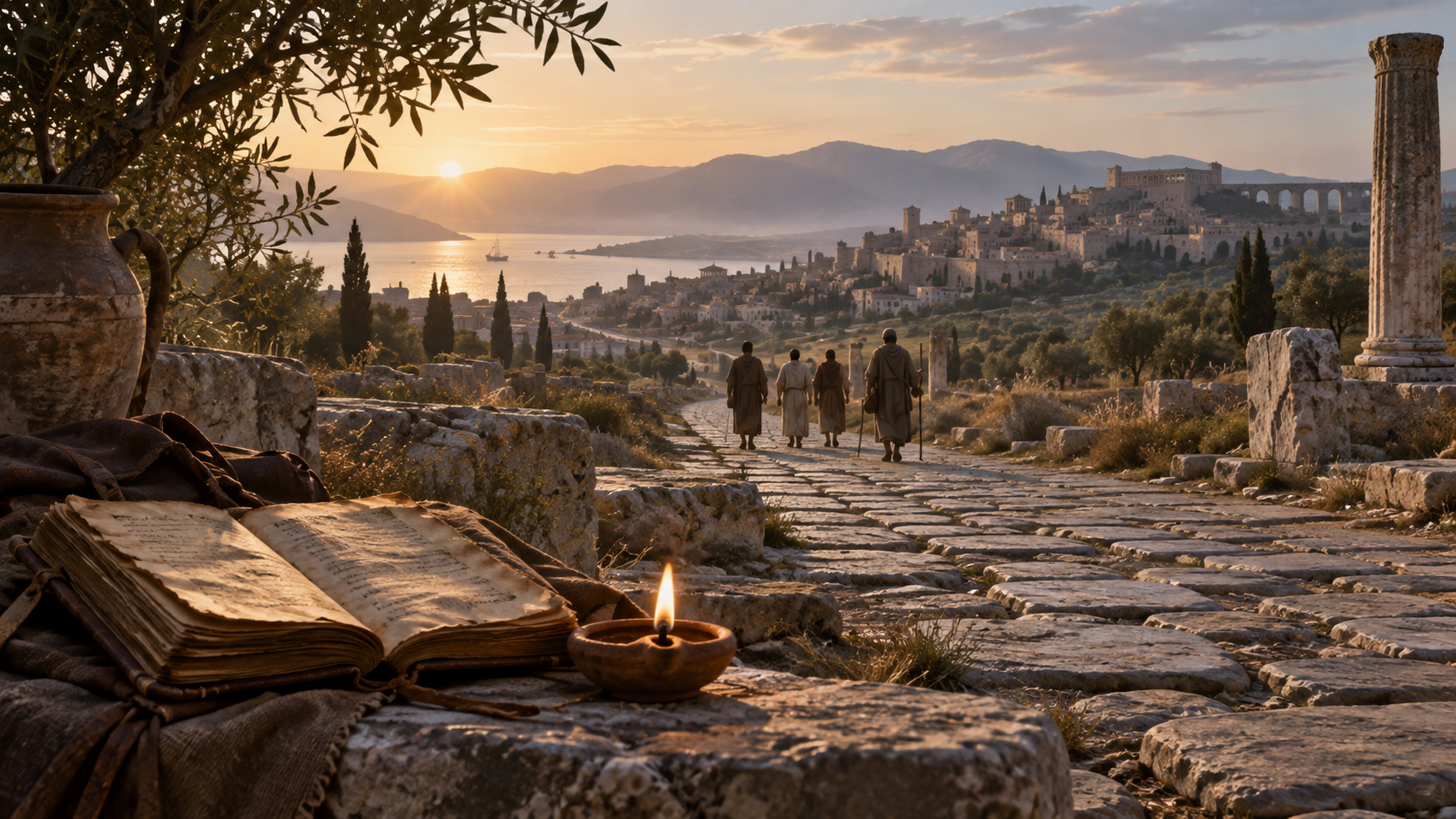
로마 도로. 지중해 세계를 일주하는 직선 도로로, 사도들과 상인들이 여권이나 비자 없이 여행할 수 있습니다.
일반적인 그리스어. 제국 전체가 하나의 언어를 사용했습니다. 즉, 복음이 하나의 언어로 전파될 수 있었습니다.
팍스 로마나. 로마의 평화 — 사람들은 전쟁을 두려워하지 않고 나라에서 나라로 여행할 수 있었습니다.
유대인 공동체. 대부분의 큰 도시에서는 이미 구약성경을 알고 있는 유대인 집단이 기꺼이 듣고자 했습니다.
도덕적으로나 영적으로 병든 제국. 사람들은 진짜 뭔가에 굶주려 있었습니다.
그러나 Pawson은 이렇게 말합니다. 이러한 이점에도 불구하고 이것은 놀라운 승리였습니다.
그들에게는 건물도, 교단도, 본부도, 재정도, 위원회도 없었습니다. 그런데도 그들은 해냈습니다.
초대교회의 조직. 매우 단순했습니다. 지역 교회에는 영적 지도력을 맡은 장로들과 실제적인 섬김을 맡은 집사들이 있었습니다. 교회들 사이를 오가며 새 교회를 세운 사도들, 복음을 전한 전도자들, 하나님의 말씀을 전한 선지자들도 있었습니다. 신약성경에서 확인할 수 있는 조직은 이것이 전부입니다.
그들의 예배. 물에 잠기는 방식의 세례, 주의 만찬의 빵과 포도주, 정해진 기도와 자유로운 기도가 함께 있었습니다. 악기나 합창단은 없었지만 그들은 노래하기를 좋아했습니다.
초대 교회 지도
예루살렘에서 로마 제국의 끝까지 (서기 30–400년)
점들은 도시의 상대적인 경도와 위도를 사용합니다. 예루살렘에서 뻗은 가는 선은 실제 여행 경로가 아니라 확장 방향을 보여 줍니다.
이것은 해안선이나 고대 경계 지도가 아니라 상대 좌표를 나타낸 도식입니다. 경도와 위도는 동서와 남북의 관계를 일관되게 유지하며, 아래의 정적 목록은 마우스를 올리지 않아도 역사적 세부 내용을 전달합니다.
세 번의 전투
Pawson의 핵심 분석 틀: 처음 4세기 동안 교회는 싸워야 했습니다. 세 가지 큰 전투 — 그리고 각각에서 승리했습니다.
첫 번째 전투 — 유대인에게서 시작된 영적 전투입니다. 두 번째 전투 — 그리스인에게서 시작된 지적 전투입니다. 세 번째 전투 — 로마인에게서 시작된 물리적 전투입니다.
Pawson의 말입니다. 우리는 오늘도 같은 세 번의 전투를 벌이고 있습니다. 이것이 그가 역사를 가르치는 이유입니다. 이것은 과거의 일이 아니기 때문입니다. 그것은 현재입니다.
세 가지 전투, 서기 30–400년
초대 교회가 싸워 이겨 낸 세 가지 전투
서로 다른 세 압박, 서로 다른 세 대응, 그리고 군대 없이 견뎌 낸 공동체의 한 이야기
- 서기 30–400년 이상
영적 전투
압박
이단과 기독교를 다른 종교와 섞으려는 시도
대응
교회는 예수가 유일한 구원의 길이라는 고백을 지켰다.
지속된 결과
구별되고 타협하지 않는 그리스도교 정체성
- 서기 50–325년
정신적 전투
압박
영지주의, 마르키온주의, 아리우스주의와 믿음을 새롭게 규정한 철학들
대응
지도자들은 성경을 해석하고 정경과 신조를 세웠다.
지속된 결과
신조와 니케아 공의회를 통해 믿음이 분명해졌다.
- 서기 64–312년
육체적 전투
압박
네로에서 디오클레티아누스에 이르는 로마의 박해
대응
공동체들은 견뎠다. 어떤 이들은 순교했고, 다른 이들은 굴복하거나 도망쳤다.
지속된 결과
콘스탄티누스 이후 박해는 끝났고 교회는 남았다.
주요 기준점
색상 패널은 세 종류의 압박을 구분합니다. 색상 없이도 라벨과 읽는 순서가 의미를 전달합니다. 금색 점은 연속적인 시계열이 아니라 방향을 잡기 위한 기준점입니다.
첫 번째 전투: 영적 — 혼합주의에 맞서
그때나 지금이나 그리스도교는 다른 종교와 혼합되어야 한다는 대중적인 생각이 있습니다. 모든 종교는 기본적으로 동일합니다. 우리는 모두 서로 다른 길을 통해 같은 하나님께로 여행하고 있습니다.
Pawson은 종교 지식을 가르치기 위해 훈련을 받은 학생인 히치하이커를 태운 이야기를 들려줍니다. 그 청년은 신을 믿지 않았지만 그의 목표는 모든 종교가 근본적으로 동일하다는 것을 아이들에게 보여주는 것이었습니다.
이것이 초대교회가 직면한 영적 싸움이었습니다.
첫 번째 순교자: 스데반
예수님을 위해 목숨을 바친 첫 번째 사람은 스데반이었고, 그는 바로 이 한 가지를 위해 죽었습니다. 그리스도교는 유대교와 결코 섞이지 않을 것이라고 선언한 것입니다. 유대교는 낡았고, 그리스도교는 독특하며 희석될 수 없다는 선언이었습니다.
유대인들은 화가 나서 그를 성 밖으로 끌고 나가 돌로 쳐 죽였습니다.
예수님 자신도 그 둘이 섞이지 않을 것임을 아셨습니다. Pawson은 자신의 가르침을 회상합니다. 그렇게 하는 것은 새 포도주를 낡은 가죽 부대에 붓는 것, 또는 낡은 옷에 새 천 조각을 꿰매 붙이는 것과 같습니다 — 얼마 지나지 않아 옷이 당겨져 찢어집니다. 이 둘은 혼합될 수 없습니다.
그러나 싸움은 스데반에게서 끝나지 않았습니다. 바울도, 베드로도 끌려갔습니다. 손끝까지 유대인이었던 베드로는 하나님께서 그에게 새롭게 가르치실 때까지 이방인을 만날 생각조차 하지 못했습니다. 서기 70년에 로마 군대가 예루살렘 성전을 파괴했을 때 사람들은 유대교의 종말이라고 생각했을 것입니다. 하지만 그렇지 않았습니다.
그 후 300년 동안 다양한 종파는 그리스도인들을 유대 율법 아래로 끌어들이려고 계속 노력했습니다. Pawson이 예로 드는 이름은 다음과 같습니다. 나사렛 사람들과 에비오나이트 — 이들은 이방인 개종자들도 여전히 모세의 율법과 안식일을 지켜야 한다고 주장했습니다. 그들은 3세기 동안 지속되었습니다.
Pawson은 이렇게 관찰합니다. “오늘날에도 그렇게 하는 사람들이 있습니다. 제칠일안식일예수재림교인도 선한 그리스도인입니다. 그들 가운데 많은 이들이 우리를 다시 제칠일 안식일의 율법 아래로 데려가려 합니다.”
마침내 전투에서 승리했습니다. 그리스도교는 독특하고 혼합되지 않았으며 유대교로부터 독립되었습니다.
판테온과 혼합주의의 죄
로마 제국이 확장됨에 따라 그들은 판테온(문자 그대로 "모든 신의 집"(판 = 모든 것, 테온 = 신))을 건설했습니다. 새로운 종교가 나타날 때마다 그 종교의 신상이 벽감에 세워졌습니다.
로마인들은 그리스도인들에게 그 벽감 하나에 예수님의 상을 놓으라고 초대했습니다.
그리스도인들은 거절했습니다. 단호히 거절했습니다.
Pawson은 다음과 같이 관찰합니다. 그가 판테온을 방문했을 때 모든 벽감은 비어 있었습니다. 그러나 예수님의 상은 있었습니다. 건물이 결국 교회에 인수되어 예배 장소로 바뀌었기 때문입니다. 그것은 타협이 아니라 승리였습니다.
그 정책이 바로 혼합주의(syncretism), 곧 서로 다른 종교를 섞는 일이었습니다. 이것이 교회가 맞서 싸워야 했던 문제였습니다.
“Religio licita” — 합법 종교
로마 제국에는 종교 등록 제도가 있었습니다. 등록된 종교는 religio licita, 곧 국가가 인정한 합법적 종교로 여겨졌습니다.
그리스도인들은 종교로 등록하기를 거부했습니다. 그들은 말했습니다. “우리는 종교가 아닙니다. 우리는 예수 그리스도를 따르는 사람들입니다.”
이로 인해 그들의 삶은 훨씬 더 위험해졌습니다.
카이사르가 신이 되었을 때
점차 모든 종교가 판테온에서 자기 자리를 찾았고, 마침내 가이사의 상도 그곳에 세워졌습니다. 카이사르는 신이 되었습니다. 로마 제국은 이렇게 선언했습니다. “이제부터 우리의 종교는 가이사 숭배다. 가이사에게 향을 피우고 ‘가이사께서는 주님이시다’라고 말하라.”
그때부터 육체적 전투가 시작되었습니다.
여기에는 “무신론자”라는 비난을 둘러싼 흥미로운 역설이 있습니다. 로마인들은 그리스도교인이 로마의 신들을 숭배하지 않는다는 이유로 그들을 무신론자라고 불렀습니다. 반대로 그리스도교인들은 로마인들이 신이 많다고 말하면서도 참 하나님을 모른다는 뜻에서 그들을 그렇게 여길 수 있었습니다. 성경에서 “무신론자”라는 말은 한 번만 나오며, 바울은 바울의 에베소서에서 이방인들이 “세상에서 하나님이 없는 자”였다고 말합니다.
그래서 바울은 아테네 사람들에게 이렇게 말했습니다. “내가 너희를 보니 범사에 종교심이 많도다. 내가 두루 다니며 너희의 위하는 것들을 보다가 ‘알지 못하는 신에게’라고 새긴 단도 보았으니, 그런즉 너희가 알지 못하고 위하는 그것을 내가 너희에게 알게 하리라.” 그들은 신을 많이 섬겼지만 참 하나님을 알지 못했습니다.
두 번째 전투: 지적 전투 — 철학에 맞서다
이 전투는 앞선 전투보다 더 치열했기 때문에 교회 밖이 아니라 교회 안에서 벌어졌습니다.
그리스인들은 뛰어난 사상가들이었습니다. 그들은 지식인이었고 모든 것을 알고 있다고 여겼습니다. 기독교가 지식인의 세계와 마주했을 때 가장 큰 위험은 지식인들이 기독교를 바꾸어, 자신들이 더 우월하다고 주장하는 형태를 만들고 지성에 맞추기 위해 진리를 타협하는 것이었습니다.
Pawson은 다음과 같이 말합니다. "내 지성에 대해 아직 답을 얻지 못한 많은 질문이 있습니다. 하지만 내 지성이 완전히 만족되기 전에 믿을 준비가 된 지점에 도달한 하나님께 감사드립니다."
이 전투는 말과 펜으로 싸워야 했으며, 교회 역사상 가장 훌륭한 저작 중 일부가 여기에서 나왔습니다. 이레나이우스는 이단에 맞서라는 제목으로 다섯 권의 책을 써 영지주의 사상의 모든 분야를 체계적으로 반박했습니다. 알렉산드리아의 오리겐은 신앙을 수호하기 위해 6,000권의 책·편지·소책자를 남겼다고 전해집니다. 초기 교회의 지적 무기고는 막강했습니다.
마르시온과의 전투
마르키온(Marcion)은 성경에 가위를 들이댄 최초의 사람이라고 할 수 있습니다. 그는 구약의 진노하시는 하나님을 싫어했고, 구약의 하나님은 신약의 하나님과 다른 신이라고 결론 내렸습니다.
그의 해결책은 구약성서 전체를 잘라내는 것이었습니다.
그러나 그는 더 잘라내야 한다는 것을 깨달았습니다. 요한계시록은 구약성경과 너무 비슷해 보였고, 바울의 글에도 그가 불편해하는 말이 있었습니다. 복음서에도 마음에 들지 않는 구절이 있었습니다.
Pawson은 이렇게 말합니다. "그는 성경에 가위를 대면 멈출 수 없다는 사실을 처음으로 발견했습니다."
그 결과 그는 두 신, 곧 구약의 신과 신약의 신을 만들었습니다.
그것은 오늘날 우리가 여전히 싸우고 있는 이단입니다.
영지주의와의 전쟁
이것은 훨씬 더 큰 전투였습니다. 영지주의는 이집트, 페르시아, 인도인의 사상과 하나의 기본 철학이 혼합되어 탄생했습니다.
영적인 것은 좋습니다. 물질적인 것은 악하다.
이로 인해 일련의 해로운 결론이 도출되었습니다.
- 물질이 악하다면 → 신은 그것을 창조할 수 없었을 것이다.
- 물질이 악하다면 → 예수님은 육체를 가질 수 없었을 것입니다.
- 그러므로 → 예수님은 겉으로만 몸을 가진 것처럼 보였을 뿐입니다. 그는 유령이었다는 것입니다.
- 그러므로 → 그는 실제로 죽지 않았습니다. 그는 결코 배고프거나 피곤하지 않았습니다.
- 그러므로 → 육체의 부활은 터무니없는 것이다.
Pawson은 이렇게 설명합니다. "이것이 요한이 자신의 복음서와 첫 번째 서신을 쓴 이유입니다. 그는 교회 내부에서 이러한 생각에 맞서 싸우고 있었습니다."
요한일서의 시작은 이렇습니다. “우리가 들은 바요, 눈으로 본 바요, 우리가 자세히 보고 우리의 손으로 만진 것—이것을 우리가 생명의 말씀에 관하여 전합니다…” — 이것은 영지주의에 맞서는 증언입니다.
교회의 위대한 사상가들도 이에 맞섰습니다. 북아프리카 카르타고의 테르툴리아누스, 알렉산드리아의 클레멘스와 오리겐, 그리고 키프리아누스는 모두 이 사상을 반박하는 글을 썼습니다.
지적 전투의 세 가지 성취
교회는 이 전투에서 승리하기 위해 세 가지 일을 했습니다.
1. 신약성경의 정경. 거짓 복음이 너무 많이 퍼지면서 교회는 무엇이 참된지 분별해야 했습니다. 그래서 예수님에게서 직접 진리를 받은 사도들에게까지 거슬러 올라가는 책들을 모았습니다. 서기 200년 무렵에는 신약성경이 형성되어 있었습니다. 그 싸움 덕분에 오늘날 우리는 신약성경을 갖고 있습니다.
2. 신조. 신앙을 명확하게 표현하기 위해 교회는 신조를 만들기 시작했습니다. 신조는 “나는 믿는다”라는 뜻입니다. 사도신경은 영지주의에 대한 직접적인 대답입니다.
- “나는 전능하신 하나님 아버지, 천지를 만드신 하나님을 믿사오며” — 하나님께서 물질적 세계를 창조하셨습니다.
- “예수께서는 본디오 빌라도에게 고난을 받으사 십자가에 못 박혀 죽으시고 장사되셨으며” — 예수님은 실제 몸을 가지셨습니다.
- “나는 몸의 부활을 믿습니다” — 몸의 부활도 선합니다.
3. 공의회. 공의회는 교회를 단순히 조직하기 위한 것이 아니라, 믿음을 지키기 위해 함께 싸우고 대열을 정비하기 위한 것이었습니다.
아리우스주의와의 싸움 — 예수님은 완전한 하나님인가?
콘스탄티누스는 서기 312년 기독교인이 되었을 때 교회가 격렬한 논쟁에 휩싸여 있음을 알게 되었습니다. 논쟁의 중심에는 알렉산드리아 출신의 재능 있는 설교자 아리우스가 있었습니다. 그의 주장은 오늘날 여호와의 증인이 가르치는 것과 비슷했습니다. 곧 예수 그리스도는 완전한 하나님이 아니라는 것이었습니다.
아리우스는 이렇게 말했습니다. 예수님은 “하나님의 아들”이지만 하나님 자신은 아닙니다. 그분은 나신 것이 아니라 창조되셨습니다. 신적인 존재이기는 하지만 하나님은 아닙니다.
이 사상은 유행처럼 교회 전체를 휩쓸었고, 제국의 거의 모든 지역이 아리우스를 따르는 듯 보였습니다.
오직 한 사람만이 무슨 일이 일어나고 있는지 보고 감히 저항했습니다.
그의 이름은 아타나시우스였습니다. 그는 젊은 집사였고 체구도 작았습니다. 어떤 사람들은 그를 난쟁이라고 불렀습니다. 아리우스는 수천 명의 추종자를 거느린 키가 크고 지휘력이 뛰어난 주교였습니다. 아타나시우스는 "그것은 잘못된 것입니다. 그리고 나는 이에 맞서 싸울 것입니다."라고 말했습니다.
라틴어 속담이 탄생했습니다. 아타나시우스 콘트라 문둠 — "세계에 맞서는 아타나시우스."
그는 일생 동안 네 명의 황제에 의해 다섯 번이나 추방당했습니다. 그는 결코 포기하지 않았습니다.
나는 팔십육 년 동안 그분을 섬겼지만 그분은 나에게 나쁜 짓을 한 적이 없습니다. 그러면 내가 어찌 내가 섬기는 왕을 모독하리이까? — 폴리갑 (서기 155년경)
영지주의의 연쇄
하나의 거짓 전제가 믿음 전체를 풀어 버린다
팝슨은 영지주의가 하나의 잘못된 생각에서 시작한 뒤, 도미노가 넘어지듯 기독교 신앙의 각 기둥을 차례로 부정했다고 보여 줍니다.
물질은 악하고 영은 선하다
거짓 전제
→ 하나님은 물질을 창조하실 수 없었다
창조주를 부정함
→ 예수에게는 실제 몸이 있을 수 없었다
성육신을 부정함
→ 예수는 단지 유령이었다 — 결코 배고프거나 피곤하지 않았다
그분의 인간성을 부정함
→ 그분은 실제로 십자가에서 죽지 않았다
십자가를 부정함
→ 몸의 부활은 터무니없다
부활을 부정함
교회의 대답
“말씀이 육신이 되어 우리 가운데 거하셨다.” — 요한복음. 요한은 바로 첫 단계에서 이 연쇄를 멈추기 위해 복음서와 서신을 기록했다.
니케아 공의회 — 서기 325년
교회의 신학을 영원히 바꾼 한 글자
아리우스의 가르침
ὁμοιούσιος
homoiousios
“유사한 본질” — 예수는 하나님과 비슷하지만 하나님은 아니다. 예수는 영원히 나신 분이 아니라 창조된 존재다.
함의:
예수가 완전한 하나님이 아니라면 하나님과 인간을 참으로 이어 줄 수 없고, 믿음 전체가 무너진다.
아타나시우스가 변호한 것
ὁμοούσιος
homoousios
“같은 본질” — 예수는 하나님이시다. 단지 하나님과 비슷한 분이 아니라 아버지와 존재가 하나이시다.
성경적 근거:
“태초에 말씀이 계셨고… 말씀은 하나님이셨다.” — 요한복음
차이: 글자 ι 하나(이오타)
한 글자, 이오타 하나가 “예수는 하나님과 비슷하다”와 “예수는 하나님이시다”를 가른다. 그래서 팝슨은 이렇게 말한다. “한 단어 때문에 교회를 나누는 것이 이상하게 보였지만, 그것은 매우 중요한 단어였다.”
아타나시우스 — 세상에 맞서다
아리우스주의가 유행처럼 제국을 휩쓸 때, 젊고 몸집이 작은 집사 아타나시우스는 홀로 섰다. 네 명의 서로 다른 황제가 그를 다섯 번 유배 보냈다. 라틴어 격언은 Athanasius contra mundum, 곧 “세상에 맞선 아타나시우스”다. 결국 그는 승리했다.
니케아 신경 (서기 325년): “…한 분 주 예수 그리스도, 하나님의 독생자, 모든 세대 전에 아버지에게서 나신 분, 하나님에게서 나신 하나님, 빛에서 나신 빛, 참 하나님에게서 나신 참 하나님, 나시고 창조되지 않으신 분, 아버지와 동일본질이신 분…”
니케아 공의회(서기 325년)
콘스탄티누스는 제국 전역에서 약 300명의 주교를 소집했습니다. 당시 콘스탄티노플에는 충분히 큰 회의장이 없었기 때문에 주교들은 마르마라해를 건너 니케아(오늘날 터키의 이즈니크)로 갔습니다.
주교들은 몸에 박해의 흔적을 지닌 채 회의장에 들어왔습니다. 포슨의 표현대로 "불구자들과 절름발이들이 들어왔습니다." 육체적인 싸움은 이제 막 끝났고, 그 베테랑들은 정신적인 싸움을 하기 위해 그 방에 앉아 있었습니다.
아타나시우스는 아직 집사에 불과했고 주요 토론에 참석하기에는 너무 어렸기 때문에 회의장 밖에 앉아 있었습니다. 그러나 그는 논쟁의 중심 인물이었습니다. 그는 친구를 통해 계속 논점을 전달했습니다. 그 친구가 안으로 달려가 아타나시우스의 주장을 제시한 다음, 밖으로 나와 아리우스의 답변을 전하면 아타나시우스가 이에 반박했습니다.
논쟁은 두 단어를 중심으로 전개되었습니다.
- ὁμοούσιος (homoousios): 예수님은 아버지와 "동일한 본질"을 가지셨습니다 — 예수님은 하나님이십니다.
- ὁμοιούσιος (homoiousios): 예수님은 "비슷한 본질"을 가지셨습니다 — 예수님은 하나님과 같은 분은 아닙니다.
차이점: 한 글자 ι (이오타). 그러나 그것은 믿음과 이단의 차이였습니다.
아타나시우스가 승리했습니다. 니케아 공의회는 니케아 신경을 발표했습니다.
“내가 한 주 예수 그리스도를 믿사오니… 하나님 중의 하나님이시요 빛 중의 빛이시요 참 하나님이시요 참 하나님이시요, 나시되 지음을 받지 아니하시고 아버지와 본질이 같으니…”
그리고 매 크리스마스마다 우리는 아직도 다음과 같은 노래를 부릅니다. "들어라! 헤럴드 천사들이 노래한다 - 하나님의 하나님, 영원한 빛의 빛..." 우리는 니케아 공의회 결과를 노래하고 있습니다.
세 번째 전투: 물리적인 전투 - 로마의 박해에 맞서다
처음 네 세기 동안 교회는 복음을 확립하기 위해 결코 물리적인 힘을 사용하지 않았습니다. 종교재판은 훨씬 뒤의 일입니다. 그들이 사용한 유일한 힘은 사랑이었습니다.
그러나 물리적 힘은 계속해서 그들을 향했습니다.
그리스도인들은 왜 그토록 많은 고난을 겪었습니까?
사람들은 기독교인들이 식인종이다(주의 만찬에 대한 오해), 음란한 “애찬 잔치”를 열었다는 것, 정상적인 사회 관습에 참여하기를 거부했다는 것, 제국의 안전을 위협하는 비밀 사회라는 소문을 비난했습니다.
하지만 Pawson은 진짜 이유가 따로 있다고 말합니다.
진짜 이유는 예수님 자신이 하신 말씀입니다. "그들이 까닭 없이 나를 미워하였도다." 인간의 마음 깊은 곳에는 하나님을 향하고, 따라서 그분의 백성을 향하는 비합리적인 증오가 있습니다.
Pawson은 여기에 맥락이 필요하다고 말합니다. 그는 “반유대주의의 또 다른 측면은 유대인들이 그리스도인들을 대하는 태도”이며 “그리스도인들에게 처음으로 반복해서 고통을 가한 이들은 유대인들이었다”고 주장합니다. (참고: 이는 Pawson이 1960년대에 제시한 방식입니다. 사도행전은 일부 유대인 지도자들의 초기 반대를 기록하지만, 현대 역사가들은 이를 유대인 전체에 집단적으로 돌리는 데 신중합니다. 이후 박해의 대부분은 유대 공동체가 아니라 로마 국가에서 나왔습니다.)
네로와 박해의 시작 (서기 64년)
어느 날 Pawson은 로마에 있는 네로의 궁전 정원 폐허에 서서 땅이 피로 젖어 있다는 것을 알았습니다.
미친 황제 네로는 로마를 대도시로 재건하려는 야망으로 도시에 불을 질렀다고 합니다. 17개 구역 중 14개 구역이 파괴되었습니다. 수백 명이 사망했습니다. 네로에게 비난이 쏟아지기 시작하자 그는 희생양을 찾았습니다. "기독교인들이 그랬습니다."
그는 로마 주변에서 붙잡을 수 있는 모든 그리스도인을 체포했습니다. 그는 일부를 들짐승의 가죽으로 싸서 개에게 물어뜯기게 했고, 일부는 참수하거나 십자가에 못 박았습니다. 또 다른 이들은 역청을 입혀 산 채로 통에 세운 뒤 정원에서 인간 횃불처럼 불태웠고, 어둠 속에서 마차를 미친 듯이 몰았습니다.
그것이 시작이었습니다. 그리고 그때부터 서기 300년까지 교회는 열 차례의 박해를 겪었습니다. 이는 교회가 지금까지 경험한 가장 끔찍한 박해였습니다.
Pawson은 중고로 얻은 오래된 책을 들고 있습니다 — 폭스의 순교서, 한때 기독교인을 위한 의무적인 일요일 독서였습니다. 그는 이 책이 기록될 때까지 기독교인들이 10년 동안 한 번도 순교하지 않은 시기가 없었다는 점을 지적합니다. "그리고 지금도 그렇습니다."
밧모 섬의 사도 요한
서기 95년 무렵, 도미티아누스 황제는 열두 사도 가운데 마지막 생존자인 요한을 소금 광산으로 유배한 뒤 에게해의 작은 섬 밧모로 보내 그곳 감옥 벽에 쇠사슬로 묶었습니다.
그 유배지에서 요한계시록이 나왔습니다. 이는 번연이 훗날 베드퍼드 감옥에서 천로역정을 쓴 것과 같습니다.
Pawson은 바울의 말을 인용합니다. “나는 매임에도 불구하고 하나님의 말씀은 매이지 아니하니라.”
플리니우스와 트라야누스 (서기 110년경)
서기 110년경, 새로운 총독 플리니우스가 소아시아의 비티니아에 도착했습니다. 그는 놀랐습니다. 이교 사원은 버려졌고, 우상을 숭배하는 성소는 더 이상 운영되지 않았습니다. 그는 이유를 물었습니다.
"기독교인들이죠. 너무 많아요."
플리니우스는 기독교인들을 체포하고 처형하기 시작했습니다. 그러나 그는 점점 늘어나는 숫자와 삶의 질에 대해 의아해했습니다. 마침내 그는 이른 아침 예배에 스파이를 보냈습니다.
그 스파이는 이렇게 보고했습니다. “그들은 동이 트기 전에 모입니다. 그들은 하나님이신 그리스도께 찬송을 부릅니다. 그런 다음 도둑질하지 않고, 간음하지 않고, 살인하지 않겠다고 맹세합니다.”
플리니우스는 너무 당황하여 트라야누스 황제에게 편지를 썼습니다. 트라야누스의 대답: 익명의 고발을 받아들이지 마십시오. 그러나 누군가가 반로마 종교로 확인되면 그들이 "카이사르는 주님이다"라고 말할 것인지 시험해 보십시오. 그렇지 않다면 실행하십시오.
안티오키아의 이그나티우스
이그나티우스는 안디옥의 주교였습니다. 포슨은 그를 "당시 가장 젊은 교회 목사 중 한 사람"이라고 부릅니다. 그는 체포되어 안디옥에서 로마로 호송되어 콜로세움에 있는 맹수들에게 던져졌습니다.
그의 여행은 승리의 행렬이었습니다. 길을 따라가는 내내 그리스도인들은 집을 떠나 그와 함께 한동안 걸으며 죽음을 향해 걸어가는 그 사람과 교제를 나눴습니다.
Pawson은 Ignatius의 편지 중 하나를 읽습니다. "이제 내가 제자를 시작하노니 칼을 가까이 하는 자는 하나님께 가깝고 들짐승 중에 있는 자는 하나님과 함께 있는 자니라."
이그나티우스는 매일 밤 쉬면서 로마 군인에게 묶인 채 잊을 수 없는 편지를 썼습니다. 그는 서머나의 감독 폴리캅에게 다음과 같이 편지를 썼습니다. "자주 맞더라도 모루처럼 굳건히 서라."
40년 후 폴리갑은 순교했다.
서머나의 폴리갑 (서기 155년경)
황제를 기리기 위해 로마 경기가 스미르나에서 열렸습니다. 군중은 점점 더 흥분했습니다. 피가 흐르기 시작했습니다. 그러자 누군가가 “무신론자들은 물러가세요!”라고 외쳤습니다. 그리고 11명의 그리스도교인이 무신론자라고 불리며 경기장으로 끌려가 사자들에게 던져졌습니다. 그러자 군중은 폴리캅을 부르짖었습니다.
그를 체포하기 위해 군인이 파견되었습니다. 그들은 스미르나 외곽의 작은 오두막에 이르렀습니다. 그들이 문을 두드리자 폴리갑이 문 앞에 나타났습니다. 그들은 그를 알아보지 못하고 “여기 폴리갑이라는 사람이 있습니까?”라고 물었습니다.
그는 아니라고 말할 수도 있었습니다. 그는 유혹을 받았습니다. 그러나 주님은 그에게 승리를 주셨습니다. 그는 “나는 폴리갑이다”라고 말하고 손목을 내밀어 쇠사슬을 묶게 했습니다.
경기장에서 주지사는 노인의 백발을 바라보며 이렇게 말했습니다. "나이를 불쌍히 여기십시오. 그리스도를 저주하기만 하면 집으로 돌아갈 수 있습니다."
폴리캅은 이렇게 대답했습니다.
“내가 팔십육 년 동안 그분을 섬겼으나 그분은 나에게 악한 일을 행하신 적이 없으시니, 내가 어찌 내가 섬기는 왕을 모독하리이까?”
그들은 그를 죽이는 것 외에는 아무것도 할 수 없었습니다. 사자들이 끌려 나간 뒤 모닥불을 피우고 그를 기둥에 묶었습니다. 그러나 바람이 강해서 폴리갑의 불길을 날려버렸고 이는 군중에게 깊은 인상을 남겼습니다. 마침내 한 로마 군인이 노인을 불쌍히 여겨 그의 심장에 단검을 꽂았습니다.
그리스도인들은 그 순교를 기록하고 다음과 같은 말로 그 이야기를 끝맺었습니다. “...퀸투스 스타티우스 콰드라투스는 집정관이지만 예수 그리스도는 영원히 왕이십니다.” 콰드라투스의 이름은 집행자로 기록되지만, 예수 그리스도의 이름은 왕으로 남습니다.
리옹의 블란디나(서기 177년)
박해는 프랑스까지 퍼졌습니다. 리옹에서는 연로한 주교 포티누스가 감옥에 투옥되어 그곳에서 사망했습니다. 그런 다음 그들은 십대의 어린 노예 소녀를 데려갔습니다. 그녀의 이름은 블란디나였습니다.
그들은 아침부터 저녁까지 그녀를 고문했습니다. 그러나 그녀를 괴롭히던 사람들은 지쳐 버렸고, 자신들이 패배했음을 인정했습니다. 더는 그녀에게 아무것도 할 수 없었습니다.
그녀의 고통 속에서의 위로와 안도감은 다음과 같은 반복된 외침이었습니다. "나는 기독교인입니다. 우리는 나쁜 짓을 한 적이 없습니다."
다음 날, 채찍질을 당하고 들짐승에게 노출되고 뜨겁게 달군 의자에 놓인 뒤, 그녀는 그물에 싸여 황소 앞에 던져졌습니다. 황소가 그녀를 뿔로 내던졌고, 그녀는 죽었습니다.
역사가는 다음과 같이 기록합니다. "그녀는 마치 자기 자녀들을 응원하던 고귀한 어머니처럼 마치 결혼 잔치에 초대받은 것처럼 기쁨과 환희로 그들에게 서둘러 다가갔습니다."
북아프리카 감옥에 갇힌 여자
Pawson은 북아프리카의 또 다른 이야기를 들려줍니다. 한 기독교 여성이 투옥되었습니다. 그녀의 아기는 옆집 감방에 있었습니다. 굶주리고 울고 있었습니다. 그녀는 아이에게 젖을 먹이는 것이 허용되지 않았습니다. 그녀를 괴롭히는 사람들은 다음과 같은 제안을 했습니다. "카이사르가 주님이라고 말하자마자 아기에게 젖을 먹일 수 있습니다."
그녀는 거절했습니다. 그리고 그녀의 대답은 이랬습니다.
"우리는 가이사를 가이사로서 존경하고, 그리스도를 주로서 경외하며 경배합니다."
데시우스와 디오클레티아누스의 박해
약 30년 동안 평화를 누린 뒤, 데키우스 황제(서기 249~251년) 치하에서 로마는 처음으로 제국 전체에 걸쳐 그리스도교를 체계적으로 분쇄하려 했습니다.
Pawson은 그때가 많은 그리스도인에게 슬픔의 시기였다고 말합니다. 일부는 박해를 피해 신앙을 포기했고, 일부는 “가이사는 주님이시다”라고 말했으며, 일부 관리들은 뇌물을 받았고, 또 일부는 도망쳤습니다. 평화가 돌아오자 그리스도를 부인했던 사람들이 교회로 돌아오려 했습니다. 교회는 그들을 어떻게 받아들일지를 두고 거의 둘로 찢어졌습니다.
데키우스 이후 약 40년 동안 평화가 이어졌고, 교회는 수와 부와 영향력 면에서 성장했습니다.
그런 다음 “사탄의 마지막 발악”이 왔습니다. 디오클레티아누스 황제 치하에서 서기 303년, 모든 교회를 허물고, 모든 성경을 불태우고, 로마 공직에 있는 모든 그리스도인을 해임하고, 모든 그리스도인을 참수하거나 불태우거나 익사시키라는 명령이 내려졌습니다.
Pawson은 다음과 같이 기록합니다. "사탄은 자신이 지고 있다는 것을 알고 있었습니다. 지금은 기독교인이 너무 많습니다. 제국은 침략당하고 있었습니다. 그리고 이것이 마지막 전투였습니다."
열 번의 로마 박해
서기 64–311년: 네로에서 디오클레티아누스까지
이 열 개의 표지는 이야기의 방향을 잡기 위한 것입니다. 제국 전체의 박해 강도를 연속적으로 측정한 것이 아닙니다.
- 네로서기 64–68년상대적 강도
로마의 화재를 그리스도인들의 탓으로 돌렸고, 특히 도시 안에서 가장 극심했다.
- 도미티아누스서기 81–96년상대적 강도
전승은 요한이 밧모로 유배되었다고 말하며, 박해는 지역적이었다.
- 트라야누스서기 98–117년상대적 강도
이그나티우스가 순교했고, 플리니우스의 편지는 지역 정책이 고르지 않았음을 보여 준다.
- 하드리아누스서기 117–138년상대적 강도
더 온건했지만 지역적 괴롭힘은 계속되었다.
- 마르쿠스 아우렐리우스서기 161–180년상대적 강도
서기 177년 리옹 박해가 있었고 블란디나가 순교했다.
- 셉티미우스 세베루스서기 202–211년상대적 강도
기독교로 개종하는 것을 금지했고, 아프리카와 이집트에서 박해가 일어났다.
- 막시미누스 트락스서기 235–238년상대적 강도
교회 지도부를 특별히 겨냥했다.
- 데키우스서기 249–251년상대적 강도
제국 전체를 대상으로 한 최초의 체계적 박해였고, 많은 그리스도인이 배교했다.
- 발레리아누스서기 257–260년상대적 강도
감독, 성직자, 상류층 그리스도인을 겨냥했다.
- 디오클레티아누스서기 303–311년상대적 강도
대박해: 교회가 파괴되고 성경이 불태워졌으며 대규모 처형이 일어났다.
열 번의 박해 목록은 전통적인 틀입니다. 강도 칸은 글에서 묘사한 내용을 상대적으로 표시한 것이며, 정량적 자료나 모든 지역이 똑같이 고통받았다는 주장이 아닙니다.
승리: 콘스탄티누스와 밀비우스 다리(서기 312년)
서기 312년, 콘스탄티누스는 로마의 적들을 향해 진군하려 했습니다. Pawson은 그 순간에 관해 전해지는 사실과 전설을 분리하기 어렵다고 솔직하게 말합니다. 콘스탄티누스는 하늘에서 환상을 보았습니다. 그는 십자가를 보았고 다음과 같은 음성을 들었다고 전해집니다. “In hoc signo vinces” — “이 표징으로 정복하라.”
그는 모든 로마 군인의 방패에 십자가를 그렸습니다. 그리고 이렇게 선언했습니다. “이제부터 나는 그리스도인이다. 너희도 그러하다.”
Pawson은 이것이 전적으로 좋은 일인지 확신하지 못합니다. 그러나 황제는 기독교인이 되었습니다.
그리고 콘스탄티누스는 이렇게 선언했습니다.
- 일요일은 휴식의 날이 될 것입니다 (역사상 처음으로)
- 제국에서는 여성의 가치가 더 높아질 것이다
- 노예들은 합당한 대우를 받을 것이다
이로써 로마제국의 물리적 전투는 끝났다. 박해가 그쳤습니다.
그러나 영적, 정신적 싸움은 아직 완전히 승리하지 못했습니다.
콘스탄티누스의 친척인 줄리안과 이교 부흥 시도
Pawson은 이렇게 말합니다. “콘스탄틴에게는 두 명의 젊은 친척이 있었는데, 그중 한 사람이 줄리안이었습니다.” 그들은 다음과 같이 선언했습니다. “우리는 그가 한 일을 좋아하지 않습니다. 우리는 로마의 이교 신들을 복원할 것입니다.”
그들은 이교 사원을 다시 열었습니다.
아무도 오지 않았습니다.
너무 늦었습니다. 영적 전쟁에서 승리했습니다. 서기 400년 무렵에는 로마 제국 전역에서 하나의 종교만 두드러지게 되었습니다.
제국 전역으로 확산
서기 400년까지 그리스도교는 다음과 같은 수준에 이르렀습니다.
- 영국: 세인트 알반(St. Alban) – 영국 최초의 순교자로, 예수를 위해 죽은 로마 군인입니다. 우리는 아직도 그곳을 세인트 알반스(St. Albans)라고 부릅니다.
- 아프리카: 아프리카 깊숙이 퍼져나가는 교회
- 시리아와 인도: 교회가 동쪽으로 퍼짐
- 로마제국 전체: 당시 알려진 세계는 복음을 들었습니다
육체적인 싸움에서 승리했습니다. 정신적인 싸움에서 승리했습니다. 영적 싸움에서 승리했습니다.
교회는 서기 400년까지 예수 그리스도를 위해 세상을 사로잡았습니다.
박해를 통과한 성장
로마 제국 인구 중 그리스도인의 추정 비율
세 개의 추정 기준점은 변화의 규모를 보여 줍니다. 연속 관측 자료가 없으므로 매끄러운 곡선으로 연결하지 않았습니다.
약 1,000명의 신자
아주 작은 출발점
약 600만 명
콘스탄티누스의 전환점 이전 추정치
약 3,300만 명
제국 인구의 절반을 넘는 추정치
핵심은 규모의 역설입니다. 박해가 확장을 멈추게 하지 못했습니다. 수치는 여전히 추정치입니다.
추정치는 로드니 스타크의 The Rise of Christianity (1996)에서 글이 제시한 기준점을 사용합니다. 약 1,000명(서기 40년), 600만 명/약 10%(서기 300년), 3,300만 명/절반 이상(서기 350년)입니다. 보간선은 그리지 않았으며, 간격은 누락된 자료가 아닙니다.
고난 속에서 교회가 성장한 이유
Pawson은 이러한 모든 박해에 대해 두 가지 중요한 관찰을 합니다.
첫 번째 관찰 — 고통스러운 진실: 우리는 많은 순교자의 이름을 알고 있지만, 박해를 견디지 못하고 신앙을 포기한 수천 명의 그리스도인도 알고 있습니다. 어떤 이들은 “가이사는 주님이시다”라고 말했고, 일부 관리들은 뇌물을 받았으며, 일부는 달아났습니다. 이것은 고통스러운 진실입니다. 평화가 찾아오자 그들은 교회로 돌아오기를 원했고, 교회는 그들을 받아들일지를 두고 거의 둘로 찢어졌습니다.
두 번째 관찰 — 위대한 역설: 교회는 그러한 고난 속에서만큼 강력하고 빠르게 성장한 적이 없습니다.
북아프리카의 그리스도교인 테르툴리아누스는 불멸의 말을 남겼습니다. “순교자의 피는 교회의 씨앗이다.”
교회를 개척하고 싶다면 순교자를 세우십시오. 테르툴리아누스는 이렇게 말했습니다.
이것이 바로 교회가 고통을 겪은 이유에 대한 고통스러우면서도 실제적인 대답입니다. 고난은 교회의 구성원을 정제했습니다. 기드온의 군사를 감당할 수 있는 300명으로 줄였던 것처럼, 교회를 고귀한 군대로 만들었습니다.
Pawson은 결론을 내립니다. 고통에 대한 답은 제가 완전히 이해할 수 있는 것이 아닙니다. 그러나 사실은 이렇습니다: 교회는 고난받는 곳에서 성장합니다.
철의 장막 동쪽은 육체적 전투이다. 철의 장막 서쪽, 여기 영국, 우리가 있는 이곳은 정신적인 싸움입니다. 그리고 그것은 더 어렵습니다. — 데이비드 포슨
한눈에 보는 세 전투
영적 전투
서기 30–400년 이상상대: 유대교와 이교 종교
핵심 질문: 기독교를 다른 종교와 섞을 수 있는가?
수호자: 스데반, 바울, 베드로
“천하 사람 중에 구원을 받을 만한 다른 이름을 우리에게 주신 일이 없음이라.” (사도행전)
✓ 승리: 기독교의 독특하고 타협하지 않는 정체성
정신적 전투
서기 50–325년상대: 그리스의 지식인들 — 영지주의, 마르키온주의, 아리우스주의
핵심 질문: 철학이 기독교를 새롭게 정의할 수 있는가?
수호자: 이레나이우스, 터툴리안, 오리겐, 아타나시우스
“참 하나님에게서 나신 참 하나님, 나시고 창조되지 않으신 분…” (니케아 신경)
✓ 승리: 신약 정경이 형성되고 신조가 세워졌으며 니케아 공의회가 열림
육체적 전투
서기 64–312년상대: 로마 제국 — 열 차례의 박해 물결
핵심 질문: 물리적 힘이 교회를 없앨 수 있는가?
수호자: 이그나티우스, 폴리갑, 블란디나, 수많은 순교자
“그들이 어린 양의 피와 자기들이 증언하는 말씀으로써 그를 이겼으니.” (요한계시록)
✓ 승리: 콘스탄티누스, 서기 312년 — 박해가 끝남
우리는 오늘날에도 같은 싸움을 싸우고 있습니다
이것이 Pawson이 역사를 가르치는 이유입니다.
오늘날의 영적 전쟁: 이 강의가 시작되기 불과 몇 주 전인 1960년대, 케임브리지에서 가장 유명한 교회에서 불교도, 힌두교도, 바하이교도, 유대인, 그리스도인이 함께 예배하는 “세계 신앙 회의” 예배가 열렸습니다. 참가 조건은 예수 그리스도의 이름을 언급하지 않는 것이었습니다.
그것이 바로 우리가 싸우고 있는 싸움입니다.
성경은 통일된 세계 종교가 있을 것이라고 예언합니다. 그리고 그 체계에 참여하기를 거부하는 사람들은 음식을 사는 것조차 허용되지 않을 것입니다(요한계시록).
오늘의 정신적 전투: 우리 시대의 철학은 영지주의라고 불리는 것이 아니라 실존주의라고 불립니다. 장폴 사르트르의 문학, 드뷔시의 음악, 피카소의 예술, 대중문화와 젊은이들의 마약 문화에서 그것을 찾을 수 있습니다. 마셜 매클루언의 선언 *“매체는 메시지다”*에서도 볼 수 있습니다. 신학에서는 불트만과 틸리히에게서, 그리고 논쟁적인 책 하나님께 정직하다를 쓴 울위치의 주교 존 로빈슨과 당시 침례교 연합 회장이었던 하워드 윌리엄스에게서 볼 수 있습니다.
이들은 이교 철학에 따라 그리스도교를 재정의하는 사람들입니다. 그 철학은 근본적으로 무신론적이며 하나님을 비인격적이거나 존재하지 않는 분으로 만듭니다. “신은 죽었다”는 문구는 그리스도교 신학자들이 이 철학을 따른 결과로 나타났습니다.
Pawson은 정신적인 전투에는 우리가 길러 낼 수 있는 최고의 지성이 필요하다고 말합니다. 말과 펜으로 싸워야 합니다. 그리고 우리에게는 "이것은 기독교 신앙이 아닙니다. 이것은 우리가 믿는 것이 아닙니다."라고 말할 수 있는 용기가 필요합니다.
오늘의 물리적 전투: 철의 장막 동쪽(이 강의는 냉전 시대에 진행됨)에서는 1세기와 마찬가지로 물리적 전투가 격렬합니다.
Pawson은 루마니아 공산주의 감옥에서 고문을 당했고 이 회의에도 참석했던 리처드 웜브란트에 대해 이야기합니다. 웜브란트는 “세계 신앙 대회” 예배를 주최하고 예수님을 동성애자라고 부른 성직자와 맞서기 위해 케임브리지로 가는 길이었습니다.
이 강의가 있기 450년 전에 마틴 루터(Martin Luther)는 그의 논문을 교회 문에 못 박았습니다. 포슨이 묻는다. "오늘은 교회 문에 못을 박으러 어디로 갈까요?" 이것이 정신적인 싸움이다. 여기 있습니다. 우리 교회 안에 있습니다.
Pawson은 다음과 같이 결론을 내립니다.
“동쪽에서 이미 육체적 전투를 벌인 웜브란트에게 두 전투를 모두 치르는 일을 왜 맡겨야 합니까? 이것이 우리가 싸워야 하는 전투입니다. 그리고 우리는 매우 명확하고 사랑스럽게 말해야 합니다. 이것이 믿음입니다. 우리는 오늘날의 지식인들을 위해 그것을 바꾸지 않습니다. 이것이 구원하는 유일한 복음입니다.”
세 전투가 남긴 세 가지 지속되는 유산
타협하지 않는 정체성
교회는 종교들을 섞으라는 압박 속에서도 예수에 대한 고백을 지켰다.
분명한 형태를 얻은 믿음
성경, 정경, 신조는 교회가 지적 도전에 답하도록 도왔다.
견뎌 낸 공동체
공동체들은 박해를 견뎠다. 콘스탄티누스 이후 박해는 끝났지만 이야기는 끝나지 않았다.
유산은 장식용 이미지가 아니라 교회가 정체성을 지키고 믿음을 분명히 표현하며 압박 속에서 살아가는 방식이다.
Note: This post is compiled from David Pawson's History of the Church lecture series (Part 1: AD 30–400), approximately 58 minutes long. All major arguments come directly from Pawson. Wherever I looked something up, checked it against the historical sources, or corrected a small detail, I've left it as an amber margin note woven right into the text — the way you'd jot in the margin of a book you're reading.
The most astonishing story in history
Paul’s letter to the Romans: "Their voice has gone out to all the earth, and their words to the ends of the world."
David Pawson opens with a simple but stunning question: How did Christianity spread from a handful of fishermen in AD 30, across the then-known world by AD 400, replacing every other religion along the way?
They did it without an army. Without money. Without influential people. And they did it against the full might of the Roman Empire.
And who were they? Pawson stresses the point: mostly nobodies. Paul wrote to the church at Corinth, "Look at yourselves — not many wise, not many powerful, not many of noble birth." The early Church was largely made up of slaves and the lowest ranks of society — and yet these were the people who won an empire.
Kit's note
Two small things I checked here. First — Paul's line in Paul’s first letter to the Corinthians: the Greek reads οὐ πολλοὶ δυνατοί (dunatoi = mighty, powerful), which is why ESV/NIV/KJV render it closer to "not many powerful" than "high calling." Second — the "60 million slaves" figure Pawson liked to cite comes from Edward Gibbon (1776) and is overstated; modern estimates put it at 5–10 million slaves out of a total population of ~60–70 million (10–15%). But whatever the number, his point holds: the Church began among society's lowest.
This is the most astonishing story in human history.
The Starting Point: End of Acts (AD 60)
The Book of Acts covers the first 30 years of Church history — AD 30 to AD 60. It's an unfinished story: from Jerusalem, the capital of the sacred world, to Rome, the capital of the secular world.
But the story kept spreading outward in ripples.
Pawson summarizes the advantages the early Church had:
Roman roads. Straight roads running around the Mediterranean world, allowing apostles and merchants to travel without passports or visas.
Common Greek language. The whole empire spoke one language — the gospel could be preached in one tongue.
Pax Romana. The Roman peace — people could travel from country to country without fear of war.
Jewish communities. In most large towns, groups of Jews already knew the Old Testament and were willing to listen.
A morally and spiritually sick empire. People were hungry for something real.
And yet Pawson says: even with these advantages, this was an astonishing triumph.They had no buildings. No denominational organizations. No headquarters. No financial resources. No committees. And yet they did it.
The organization of the early Church. Utterly simple: local groups called churches, each with elders for spiritual leadership and deacons for practical service. Between churches moved apostles who planted new ones, evangelists who preached the gospel, and prophets who brought the word of God. That is the only organization you find in the New Testament.
Their worship. Baptism by immersion. Bread and wine at the Lord's Supper. A mixture of fixed prayers and free prayer. Singing — no instruments, no choirs, but they loved to sing.
Early Church Map
From Jerusalem to the ends of the Roman Empire (AD 30–400)
Points use the cities' relative longitude and latitude; fine lines from Jerusalem show the direction of expansion, not literal travel routes.
This is a relative coordinate diagram, not a coastline or ancient-boundary map. Longitude and latitude keep the east–west and north–south relationships consistent; the static list below carries the historical detail without relying on hover.
Three Battles
Pawson's core analytical framework: in the first four centuries, the Church had to fight three great battles — and in each one, it won.
The first battle — Spiritual, beginning with the Jews. The second battle — Mental, beginning with the Greeks. The third battle — Physical, beginning with the Romans.
Pawson says: we are fighting the same three battles today. That is why he teaches history — because this is not the past. It is the present.
Three Battles AD 30–400
Three battles the early Church fought and won
Three different pressures, three different responses—and one story of a community that endured without an army.
- AD 30–400+
Spiritual battle
Pressure
Heresy and attempts to blend Christianity with other religions.
Response
The Church held to the confession that Jesus is the unique way of salvation.
Enduring result
A distinct, uncompromised Christian identity.
- AD 50–325
Mental battle
Pressure
Gnosticism, Marcionism, Arianism, and philosophies redefining the faith.
Response
Leaders interpreted Scripture and formed the canon and creeds.
Enduring result
The faith was clarified through the Creed and Council of Nicaea.
- AD 64–312
Physical battle
Pressure
Roman persecution, from Nero to Diocletian.
Response
Communities endured; some were martyred, while others capitulated or fled.
Enduring result
Persecution ended after Constantine; the Church remained.
Selected orientation points
The colored panels distinguish three kinds of pressure; labels and reading order carry the meaning without color. Gold points are orientation markers, not a continuous time series.
First Battle: Spiritual — Against Syncretism
There is a popular idea — then and now — that Christianity must be mixed with other religions. That all religions are basically the same. That we're all traveling to the same God by different roads.
Pawson tells of picking up a hitchhiker, a student training to teach religious knowledge. The young man didn't believe in God, but his goal was to show children that all religions are fundamentally the same.
This is the spiritual battle the early Church faced.
The first martyr: Stephen
The first person to give his life for Jesus was Stephen — and he died for this one thing: declaring that Christianity would never mix with Judaism. That Judaism had become obsolete. That Christianity was unique and could not be diluted.
The Jews were so angry they dragged him outside the city wall and stoned him to death.
Jesus himself knew the two would not mix. Pawson recalls his teaching: to do so is like pouring new wine into old wineskins, or sewing a patch of unshrunk cloth onto an old garment — sooner or later it pulls and tears away. The two cannot be blended.
But the battle didn't end with Stephen. Paul was drawn in, and Peter was flung into it against his will — Peter, a Jew to his fingertips who had no time for Gentiles until God had to teach him otherwise. When the Temple in Jerusalem was destroyed by the Roman armies in AD 70, people might have thought that was the end of Judaism. But it wasn't.
For three hundred more years, various sects kept trying to drag Christians back under the Jewish law. Pawson names them: the Nazarenes and the Ebionites — who insisted that Gentile converts must still observe the Mosaic law and the Sabbath. They persisted for three full centuries.
"The people doing it today," Pawson observes, "are the Seventh-day Adventists — good Christians, many of them, but they are trying to bring us back under the Sabbath law of the seventh day."
Finally the battle was won: Christianity was unique, unmixed, independent of Judaism.
The Pantheon and the sin of syncretism
As the Roman Empire expanded, they built the Pantheon — literally "the house of all gods" (pan = all, theon = gods). Every time a new religion appeared, a statue of its deity was placed in a niche.
The Romans invited Christians to place a statue of Jesus in one of those niches.
The Christians refused. Absolutely refused.
Pawson observes: when he visited the Pantheon, all the niches were empty — but there was a statue of Jesus, because the building was eventually taken over by the Church and turned into a place of worship. That was victory, not compromise.
Kit's note
One honest caveat: the detail about Romans "inviting" Christians to put a statue of Jesus in the Pantheon is a lovely story but appears in no primary source — the closest analogue is Eusebius (HE 2.2), where Emperor Tiberius proposes enrolling Christ among the gods and the Senate refuses, itself a legend. (The idea that the niches held the "seven planetary gods" is also just a modern hypothesis from Mommsen; the only ancient source, Cassius Dio 53.27.2, names only Mars and Venus.) But the core fact is real: the Pantheon really was taken over by the Church — consecrated as Santa Maria ad Martyres in AD 609. That victory genuinely happened.
This policy is called syncretism — the mixing of religions. This was the battle the Church had to fight.
"Religio Licita" — Legal Religion
The Roman Empire had a religion registration system. If you registered, your religion became religio licita — a legal faith recognized by the state.
Christians refused to register. They said: We are not a religion. We are followers of Jesus Christ.
This made their lives considerably more dangerous.
When Caesar Became God
Gradually, all the religions found their niches in the Pantheon — and finally, they placed a statue of Caesar there. Caesar became a god. And the Roman Empire declared: from now on, our religion is the worship of Caesar. Burn incense to Caesar. Say "Caesar is Lord."
That is when the physical battle began.
But there is an interesting double charge of atheism: the Romans called Christians atheists because they refused to worship the Roman gods. And Christians called the Romans atheists — because despite all their gods, they had no God. The word "atheist" appears once in the Bible — in Paul’s letter to the Ephesians, where Paul tells the Gentiles they were "without God in the world."
That is why Paul at Athens said to the Athenians: "I have seen all your altars — but I noticed one inscribed: To The Unknown God. I have come to tell you about that God — the one God you do not know." Atheists, every one of them.
Second Battle: Mental — Against Philosophy
This was the harder battle because it happened inside the Church, not outside it.
The Greeks were the brilliant thinkers. The intellectuals. The know-alls. And when Christianity encountered the intellectual world, the greatest danger was that intellectuals would alter Christianity — producing what they claimed was a superior form of it, compromising truth to fit the intellect.
Pawson says: "There are many questions that I have with my intellect that I still haven't got answered. But thank God I got to the point where I was prepared to believe before I got my intellect entirely satisfied."
This battle had to be fought with words and pens — and some of the finest writings in Church history come from it. Irenaeus wrote five books under the title Against Heresies — a systematic refutation of every branch of Gnostic thought. Origen of Alexandria produced an astonishing 6,000 books, letters, and pamphlets in defence of the faith. The intellectual arsenal of the early Church was formidable.
Kit's note
About that "6,000": it comes from Epiphanius (Panarion 64.63) and is usually considered an exaggeration. A more modest figure — about 2,000 works — is often credited to Eusebius, but it's actually not in Historia Ecclesiastica 6.32 (there Eusebius declines to catalogue them); it survives via Jerome (Epistle 33), quoting the now-lost Life of Pamphilus. Whether 6,000 or 2,000, Pawson's point holds: Origen's output was extraordinary.
The battle with Marcion
Marcion was the first to take scissors to the Bible. He didn't like the God of wrath in the Old Testament, and concluded that the God of the Old Testament was a different God from the God of the New Testament.
His solution: cut out the whole Old Testament.
But then he found he needed to cut more. Revelation looked too much like the Old Testament — out. Paul said some uncomfortable things — out. Even the Gospels had passages he didn't like — out.
Pawson notes: "He was the first to discover that when you apply the scissors to the Bible, you cannot stop."
He ended up with two Gods — one for the Old Testament, one for the New.
That is a heresy we are still fighting today.
The battle with Gnosticism
This was a much larger battle. Gnosticism came from a mixture of thought — Egyptian, Persian, possibly Indian — with one basic philosophy:
Spiritual things are good. Material things are evil.
This led to a chain of damaging conclusions:
- If matter is evil → God could not have created it.
- If matter is evil → Jesus could not have had a physical body.
- Therefore → Jesus only appeared to have a body. He was a phantom.
- Therefore → He did not really die. He was never hungry or tired.
- Therefore → The resurrection of the body is absurd.
Pawson explains: "This is why John wrote his Gospel and his First Epistle — he was fighting this thinking inside the Church."
The opening of 1 John: "That which we have heard, which we have seen with our eyes, which we have looked at and our hands have touched — this we proclaim concerning the Word of life..." — that is combat against Gnosticism.
The greatest minds of the Church set themselves against it: Tertullian of Carthage in North Africa, Clement and Origen of Alexandria, and Cyprian — all wrote to refute this thinking.
Three achievements of the mental battle
The Church did three things to win this battle:
1. The New Testament Canon. With so many false gospels circulating, the Church needed to identify what was real. They collected all the books that genuinely traced back to the apostles — those who received truth directly from Jesus. By AD 200, the New Testament had been assembled. We have the New Testament today because of that battle.
2. The Creeds. To state the faith clearly, the Church began making lists — creeds (from credo = "I believe"). The Apostles' Creed is a direct answer to Gnosticism:
- "I believe in God the Father Almighty, Maker of heaven and earth" — God did make material reality.
- "Jesus... suffered under Pontius Pilate, was crucified, dead and buried" — He had a real body.
- "I believe in the resurrection of the body" — the body is good.
3. Councils. Not to organize the Church, but to share the battle and close ranks for the faith.
The battle with Arianism — Is Jesus fully God?
When Constantine became a Christian in AD 312, he discovered the Church was in a terrible state of argument. The cause: a tall, handsome, brilliantly gifted preacher from Alexandria named Arius was teaching exactly what Jehovah's Witnesses teach today — that Jesus Christ is not quite God.
Arius said: Jesus is the "Son of God" but not God Himself. He was created, not begotten. He is like God but not God.
This swept through the Church like a craze, like a women's fashion trend — almost the entire empire followed Arius.
Only one person saw what was happening and dared to stand against it.
His name was Athanasius. He was a young deacon, physically small — some called him a dwarf. Arius was a tall, commanding bishop with thousands of admirers. Athanasius said: "That is wrong. And I will fight it."
The Latin proverb was born: Athanasius contra mundum — "Athanasius against the world."
In his lifetime he was exiled five times by four different emperors. He never gave up.
Eighty and six years have I served Him, and He has never done me wrong. How then can I blaspheme my King whom I serve? — Polycarp (c. AD 155)
The Gnostic Cascade
One false premise unravels the whole faith
Pawson shows how Gnosticism began with one wrong idea, then — like falling dominoes — denied each pillar of the Christian faith in turn.
Matter is evil, spirit is good
The false premise
→ God could not have created matter
Denies the Creator
→ Jesus could not have had a real body
Denies the Incarnation
→ He was only a phantom — never hungry or tired
Denies His humanity
→ He did not really die on the cross
Denies the cross
→ The resurrection of the body is absurd
Denies the resurrection
The Church's answer
"The Word became flesh and dwelt among us." — John’s Gospel. John wrote his Gospel and Epistles precisely to stop this cascade at its very first step.
Council of Nicaea — AD 325
One letter that changed Church theology forever
Arius taught
ὁμοιούσιος
homoiousios
"of similar substance" — Jesus is like God, but not God. He was created, not eternally begotten.
Implication:
If Jesus is not fully God, He cannot truly bridge God and humanity — the entire faith collapses.
Athanasius defended
ὁμοούσιος
homoousios
"of the same substance" — Jesus IS God. Not just like God, but one in being with the Father.
Scripture basis:
"In the beginning was the Word... and the Word was God." — John’s Gospel
The difference: one letter ι (iota)
One letter — iota — separates "Jesus is similar to God" from "Jesus IS God." This is why Pawson notes: "People thought it strange to split the church over a word, but it was a very important word."
Athanasius — Against the world
As Arianism swept the empire like a fashion craze, Athanasius — a young deacon, physically small — stood alone. He was exiled five times by four different emperors. Latin proverb: Athanasius contra mundum — "Athanasius against the world." In the end, he prevailed.
Nicene Creed (325 AD): "...one Lord Jesus Christ, the only-begotten Son of God, begotten of the Father before all worlds, God of God, Light of Light, very God of very God, begotten not made, being of one substance with the Father..."
The Council of Nicaea (AD 325)
Constantine summoned about 300 bishops from across the empire — he had no room large enough in Constantinople, so they crossed the Sea of Marmara to a city called Nicaea (modern-day İznik, Turkey).
Kit's note
A small geographical correction: Constantinople didn't actually exist yet in AD 325 — Constantine only formally named the city on 11 May 330, five years after Nicaea. The real reason Nicaea was chosen was its closeness to Nicomedia, Constantine's residence at the time, so the emperor could attend and intervene easily.
The bishops entered the hall bearing the marks of persecution on their bodies — in Pawson's words, "the maimed and the lame came in." The physical battle had just ended, and its veterans were sitting in the room to fight the mental battle.
Athanasius — still only a deacon, too young to be admitted to the main debate — sat outside. But he was the central figure in the argument. He continuously passed arguments through a friend: the friend ran in, presented Athanasius's point, then ran out to relay Arius's response so Athanasius could counter it.
Kit's note
The image of Athanasius "barred from the room" is a familiar legend with no basis in the primary sources. The gentler truth: as a deacon he had no vote (that was reserved for bishops), but he was fully present in the hall and took part in the debate. The "sitting outside" detail is dramatic retelling, not quite history.
The debate turned on two words:
- ὁμοούσιος (homoousios): Jesus is "of the same substance" as the Father — Jesus is God.
- ὁμοιούσιος (homoiousios): Jesus is "of similar substance" — Jesus is like God.
The difference: one letter ι (iota). But it was the difference between faith and heresy.
Athanasius prevailed. The Council of Nicaea produced the Nicene Creed:
"I believe in one Lord Jesus Christ... God of God, Light of Light, very God of very God, begotten not made, being of one substance with the Father..."
And every Christmas, we still sing it: "Hark! The Herald Angels Sing — God of God, Light of Light eternal..." We are singing the outcome of the Council of Nicaea.
Third Battle: Physical — Against Roman Persecution
In the first four centuries, the Church never used physical force to establish the gospel. The Inquisition was to come much later. The only force they used was love.
But physical force was used against them, again and again.
Why did Christians suffer so much?
People blamed the rumors — that Christians were cannibals (a misunderstanding of the Lord's Supper), that they held obscene "love feasts," that they refused to participate in normal social customs, that they were a secret society threatening imperial security.
But Pawson says: those were not the real reason.
The real reason is the words of Jesus himself: "They have hated me without a cause." There is an irrational hatred in the depths of the human heart toward God — and therefore toward His people.
Pawson goes further — and this needs context: he argues that "the other side of anti-Semitism is the attitude of the Jews toward Christians," and that "it was the Jews who first caused the sufferings of Christians, again and again." (Note: this is how Pawson framed it in the 1960s. Acts does record early opposition from some Jewish leaders, but modern historians are cautious about such collective attribution — the great majority of later persecutions came from the Roman state, not Jewish communities.)
Nero and the beginning of persecution (AD 64)
One day Pawson stood in the ruins of Nero's palace gardens in Rome, knowing that the soil was soaked with blood.
The mad emperor Nero, in his ambition to rebuild Rome as a great metropolis, allegedly set the city on fire. Fourteen of seventeen districts were razed. Hundreds died. When blame began to fall on Nero, he looked for a scapegoat: "The Christians did it."
He arrested every Christian within reach of Rome. He wrapped them in the skins of wild beasts and set his dogs on them. He beheaded them. He crucified them. And finally — he covered them with pitch, stuffed them alive into barrels, and lit them as human torches in his garden while he drove his chariot madly around in the darkness.
That was the beginning. And from then until AD 300, the Church endured ten periods of persecution — the most frightful it had ever known.
Kit's note
The "ten persecutions" figure is more symbolic than an exact count — later historians (Sulpicius Severus, Orosius) chose ten to echo the ten plagues of Egypt and the ten horns of Revelation. Some "waves" on the list were very brief or purely local, and the one attributed to Domitian is heavily disputed by modern historians. The ferocity, though, was not exaggerated at all.
Pawson holds up an old book he picked up secondhand — Foxe's Book of Martyrs, once compulsory Sunday reading for Christians. He notes it shows that, down to the time it was written, there had never been a ten-year period without Christians suffering martyrdom — "and there still isn't."
The Apostle John on Patmos
Around AD 95, Emperor Domitian exiled John — the last of the twelve apostles — to the salt mines, then to the tiny island of Patmos in the Aegean Sea, where he was chained to a prison wall.
Kit's note
The "salt mines" is a detail I couldn't find in any primary source. Revelation only says John was on Patmos "because of the word of God"; the earliest source linking him to a mine (Victorinus, ~3rd century) just says he was condemned to labor in the mines generally — not salt mines. That detail is a later embellishment.
From that prison cell came the Book of Revelation — just as Bunyan would later write Pilgrim's Progress from Bedford jail.
Pawson cites Paul: "I may be in chains, but the word of God is not bound."
Pliny and Trajan (c. AD 110)
Around AD 110, the new governor Pliny arrived in Bithynia in Asia Minor. He was astonished — the pagan temples were deserted, the idolatrous shrines had no business. He asked why.
"The Christians, sir. There are too many of them."
Pliny began arresting and executing Christians. But he was puzzled — both by their ever-growing numbers and by the quality of their lives. Finally he sent a spy into one of their early morning services.
The spy returned with his report: "They meet before daybreak. They sing hymns to Christ as God. Then they take an oath — a sacramentum — not to steal, not to commit adultery, not to murder."
Pliny was so puzzled he wrote to Emperor Trajan. Trajan's reply: don't accept anonymous accusations, but if someone is confirmed as anti-Roman religion, test whether they will say "Caesar is Lord." If they won't — execute them.
Kit's note
For precision: Pliny governed the province of Bithynia et Pontus (northwestern Asia Minor), not all of Asia Minor; his letter (Letters 10.96–97, c. AD 111–112) is one of the earliest non-Christian documents about Christians. The spy's report — that they sang carmen Christo quasi deo, "a hymn to Christ as to a god" — is the letter's actual wording.
Ignatius of Antioch
Ignatius was the bishop of Antioch — Pawson calls him "one of the youngest ministers of the Church in those days." He was arrested and escorted from Antioch to Rome to be thrown to the wild beasts in the Colosseum.
His journey was a pageant of triumph. All along the road, Christians left their homes and walked with him for stretches, sharing fellowship with the man walking to his death.
Pawson reads from one of Ignatius's own letters: "Now I begin to be a disciple. He who is near the sword is near to God. He who is among the wild beasts is in company with God."
Ignatius wrote unforgettable letters every night as he rested — chained to his Roman soldier. He wrote to Polycarp, the bishop of Smyrna: "Stand fast, firm as an anvil, though often smitten."
Kit's note
A small note on sourcing: the passage Pawson reads as one breath actually fuses three different letters. "Now I begin to be a disciple" is from the Letter to the Romans (5.3); "He who is near the sword is near to God…" comes from the Letter to the Smyrnaeans (4.2); and "Stand fast, firm as an anvil" is from the Letter to Polycarp (3.1). All seven of Ignatius's letters (the middle recension) are accepted as authentic, written c. AD 107–110 as he was marched to Rome.
Forty years later, Polycarp was martyred.
Polycarp at Smyrna (c. AD 155)
The Roman games were being held at Smyrna to honor the emperor. The crowd grew excited. Blood began to flow. Then someone cried, "Away with the atheists!" — and eleven Christians were dragged into the arena, called atheists, and thrown to the lions. Then the crowd cried for Polycarp.
A soldier was sent to arrest him. They came to a small cottage outside Smyrna. They knocked. Polycarp came to the door. They didn't recognize him and asked: "Is there a man called Polycarp here?"
He could have said no. He was tempted to. But the Lord gave him the victory. He said, "I am Polycarp," and held out his wrists for the chains.
In the arena, the governor looked at the old man's white hair and said: "Have pity on your age. Just curse Christ and you can go back to your cottage."
Polycarp replied:
"Eighty and six years have I served Him, and He has never done me wrong. How then can I blaspheme my King whom I serve?"
They could do nothing but kill him. The lions had been taken away, so they built a bonfire and tied him to a stake. But the wind was strong and blew the flames away from Polycarp — which deeply impressed the crowd. Finally, a Roman soldier, out of pity for the old man, plunged a dagger into his heart.
The Christians recorded that martyrdom, and ended the account with these words: "...Quintus Statius Quadratus being consul, but Jesus Christ being King forever." Quadratus's name goes down as the executor. Jesus Christ's name goes down as King.
Kit's note
A small transcription slip in the recording: the proconsul's real name was Lucius Statius Quadratus, not "Quintus" (Quintus is actually a different figure in the same story — the man who apostatized at the sight of the beasts). The "eighty and six years" line, though, is entirely authentic — recorded in the Martyrium Polycarpi (~AD 155–156), the earliest surviving Christian martyrdom account.
Blandina at Lyon (AD 177)
The persecution spread to France. At Lyon, the aged minister Pothinus was thrown into prison and died there. Then they took a young slave girl in her teens — her name was Blandina.
They tortured her from morning till evening. Her tormentors grew tired and weary and acknowledged they were conquered — they could do no more to her.
Her comfort and relief in the pain was this repeated cry: "I am a Christian, and there is nothing vile done by us."
The next day — after the scourging, after the wild beasts, after the red-hot chair — she was enclosed in a net and thrown before a bull. The bull tossed her. And she died.
The historian records: "She, like a noble mother who had cheered on her children, hastened to them with joy and exultation, as though she were bidden to a marriage feast."
Kit's note
Blandina's story rests on solid ground: the source is the Letter of the Churches of Vienne and Lyon, preserved by Eusebius (Historia Ecclesiastica 5.1). She really was a slave; the aged bishop Pothinus was "more than ninety" and died in prison two days after his trial; and the very arena — the Amphitheatre of the Three Gauls at Lyon — still stands and is archaeologically confirmed.
A Woman in a North African Prison
Pawson recounts another story from North Africa. A Christian woman was imprisoned. Her infant was in the cell next door — starving, crying. She was not allowed to nurse her child. Her tormentors made the offer: "You can feed your baby as soon as you say Caesar is Lord."
She refused. And this was her answer:
"We give honour to Caesar as Caesar. But we render fear and worship to Christ as Lord."
Kit's note
This woman is most likely Vibia Perpetua, martyred at Carthage in AD 203 — her story survives in the Passio Perpetuae et Felicitatis, one of the earliest texts written by a Christian woman's own hand. One honest caveat: the "say 'Caesar is Lord' and you can feed your baby" exchange is Pawson's compressed retelling. In the original, the procurator Hilarianus demands she "sacrifice for the welfare of the emperors," and she answers simply: "I am a Christian." But the heart of it — a mother choosing Christ over her crying infant — is exactly right.
The persecutions of Decius and Diocletian
After about 30 years of peace, under Emperor Decius (c. AD 249–251), for the first time Rome systematically tried to crush Christianity empire-wide — not just locally.
Pawson says this was a time of grief because many Christians gave in. Some said "Caesar is Lord." Some bribed officials. Some fled. This created a painful problem: when peace returned, those who had denied Christ wanted to come back to the Church. What should be done? This nearly tore the Church in two.
After Decius came 40 years of peace — and the Church grew in numbers, wealth, and influence.
Then came "Satan's last fling" — under Diocletian (AD 303): he ordered every church destroyed, every Bible burned, every Christian in Roman office dismissed, and every Christian to be beheaded, burned, or drowned.
Kit's note
It actually unfolded in escalating stages, not one immediate massacre. The first edict (23 Feb 303) carried no death penalty — only church demolition, Bible burning, and loss of office; Lactantius even records that Diocletian wanted it done "without bloodshed," with Galerius pushing for executions. Only the fourth edict (early 304) required everyone to sacrifice on pain of death. Pawson's point holds — this was the largest and last persecution — it just escalated over about two years.
Pawson notes: "Satan knew he was losing. There were too many Christians now. The Empire was being overrun. And this was the final battle."
Ten Roman Persecutions
AD 64–311: From Nero to Diocletian
These ten markers orient the story; they are not a continuous measure of persecution intensity across the whole empire.
- NeroAD 64–68Relative intensity
Blamed Christians for Rome's fire; fiercest in the city itself.
- DomitianAD 81–96Relative intensity
Tradition places John in exile on Patmos; persecution remained local.
- TrajanAD 98–117Relative intensity
Ignatius was martyred; Pliny's letter shows uneven local policy.
- HadrianAD 117–138Relative intensity
More moderate, while local harassment continued.
- Marcus AureliusAD 161–180Relative intensity
The Lyon persecution in AD 177; Blandina was martyred.
- Septimius SeverusAD 202–211Relative intensity
Banned conversion to Christianity; persecution in Africa and Egypt.
- Maximinus ThraxAD 235–238Relative intensity
Targeted church leadership specifically.
- DeciusAD 249–251Relative intensity
The first systematic empire-wide persecution; many Christians apostatized.
- ValerianAD 257–260Relative intensity
Targeted bishops, clergy, and upper-class Christians.
- DiocletianAD 303–311Relative intensity
The Great Persecution: churches destroyed, Bibles burned, and mass executions.
The ten-persecution list is a traditional framing; the intensity cells are a relative encoding of the article's descriptions, not quantitative data or a claim that every place suffered equally.
Victory: Constantine and the Milvian Bridge (AD 312)
AD 312. Constantine was about to march against the enemies of Rome. And in that moment — Pawson honestly says he cannot separate truth from fiction in what has come down to us — Constantine saw a vision in the sky. He saw a cross, and heard a voice: "In hoc signo vinces" — "In this sign, conquer."
Kit's note
Pawson is admirably honest that he "can't separate truth from fiction" — and indeed the sources give two versions. Lactantius (earliest, ~AD 315) describes only a nighttime dream, with no cross in the sky and no Latin phrase. Eusebius (writing 25 years later) gives the daytime vision witnessed by the whole army; his Greek is τούτῳ νίκα ("conquer by this"). The actual sign was the Chi-Rho monogram (☧) — the first two letters of Christos — not a Latin cross; and the famous "In hoc signo vinces" appears in no ancient source (Constantine's Arch, dedicated AD 315, bears no Christian symbol at all). What's certain: after that battle, the emperor turned decisively toward Christianity.
He painted the cross on the shield of every Roman soldier. And declared: "From now on, I am a Christian. And so are you."
Pawson is not sure this was entirely a good thing. But the emperor had become a Christian.
And Constantine declared:
- Sunday would be a day of rest (for the first time in history)
- Women would be valued more highly in the Empire
- Slaves would be treated properly
That was the end of the physical battle in the Roman Empire. The persecutions ceased.
But the spiritual and mental battles were not yet fully won.
Julian, Constantine's kinsman, and the pagan revival attempt
Pawson says: "Constantine had two young kinsmen — one called Julian." They declared: "We don't like what he did. We are going to restore the Roman pagan gods."
Kit's note
Pawson calls Julian a "grandson," but he was actually Constantine's nephew — son of Julius Constantius, Constantine's half-brother. Julian reigned AD 361–363 and died of wounds sustained during his Persian campaign.
They reopened the pagan temples.
Nobody came.
It was too late. The spiritual battle had been won. By AD 400, only one religion was prominent across the Roman Empire.
The spread across the empire
By AD 400, Christianity had reached:
- Britain: St. Alban — the first martyr in Britain, a Roman soldier dying for Jesus. We still call the place St. Albans.
- Africa: The Church spread deep into Africa
- Syria and India: The Church spread eastward
- All of the Roman Empire: The then-known world had heard the gospel
The physical battle was won. The mental battle was won. The spiritual battle was won.
The Church had captured the world for Jesus Christ by AD 400.
Kit's note
On St Alban: in the two earliest sources — Gildas (De Excidio, 6th century) and Bede (Historia Ecclesiastica, AD 731) — he's described as a townsman of Verulamium (modern St Albans), a still-pagan householder who sheltered a fleeing priest and swapped clothes to die in his place. The "soldier" image only appears in later traditions, and even his martyrdom date is disputed (AD 209, 254–259, or 304).
Growth Through Persecution
Estimated % of Roman Empire population that was Christian
Three estimated anchors show the scale of change; they are not joined into a smooth curve because there is no continuous observation series.
≈1,000 believers
A very small starting point
≈6 million people
Estimate before Constantine's turning point
≈33 million people
Estimate above half of the empire
The point is a scale paradox: persecution did not stop expansion. The numbers remain estimates.
Estimates use the anchors stated in the essay from Rodney Stark, The Rise of Christianity (1996): about 1,000 (AD 40), 6 million/~10% (AD 300), and 33 million/more than half (AD 350). No interpolation line is drawn; the gaps are not missing data.
What Made the Church Grow Under Suffering
Pawson makes two important observations about all those persecutions.
First observation — The painful truth: While we know the names of many martyrs, we also know that thousands of Christians gave in under persecution. Some said "Caesar is Lord." Some bribed officials. Some fled. This is the painful truth. And when peace came, they wanted to return to the Church — which nearly tore the Christian community in two.
Second observation — The great paradox: The Church never grew so strongly or so quickly as under those sufferings.
Tertullian — the North African Christian — said the immortal words: "The blood of the martyrs is the seed of the Church."
If you want to plant a church — plant a martyr. That is what Tertullian said.
Kit's note
The numbers that make this paradox concrete: sociologist Rodney Stark (The Rise of Christianity, 1996) estimates the Church grew about 40% per decade — from ~1,000 believers (AD 40) to ~6 million (AD 300, ~10% of the empire) to ~33 million (AD 350, over half the empire). These are estimates, of course; but such a steady curve climbing straight through waves of persecution is genuinely astonishing — and it fits what the ancient sources record. (See the chart above.)
And this is the painful but real answer to why the Church suffered: because persecution sifted the membership. It reduced Gideon's men to the 300 who could take it. It made the Church what it ought to be — a noble army.
Pawson concludes: the answer to the suffering is not something I can fully understand. But it is true: where a Church suffers, it grows.
East of the iron curtain, it is the physical battle. West of the iron curtain — here in England, here where we are — it is the mental battle. And it is harder. — David Pawson
Three Battles at a Glance
Spiritual Battle
AD 30–400+Opponent: Judaism + pagan religions
Core question: Can Christianity be mixed with other religions?
Champions: Stephen, Paul, Peter
"There is no other name under heaven... by which we must be saved." (Acts)
✓ Won: Christianity's unique, uncompromised identity
Mental Battle
AD 50–325Opponent: Greek intellectuals — Gnosticism, Marcionism, Arianism
Core question: Can philosophy redefine Christianity?
Champions: Irenaeus, Tertullian, Origen, Athanasius
"Very God of very God, begotten not made..." (Nicene Creed)
✓ Won: NT Canon formed, Creeds established, Council of Nicaea
Physical Battle
AD 64–312Opponent: The Roman Empire — ten waves of persecution
Core question: Can physical force exterminate the Church?
Champions: Ignatius, Polycarp, Blandina, countless martyrs
"They overcame him by the blood of the Lamb and the word of their testimony." (Revelation)
✓ Won: Constantine 312 AD — persecutions ended
We Are Fighting the Same Battles Today
This is why Pawson teaches history.
The spiritual battle today: Just weeks before this lecture was given (1960s), at the most prominent church in Cambridge, a service was held for the "World Congress of Faiths" — Buddhists, Hindus, Baha'is, Jews, Christians, all present to worship together. Condition of participation: the name of Jesus Christ must not be mentioned.
That is the battle we are fighting.
The Bible predicts there will be a unified world religion — and those who refuse to join will not be allowed to buy food (Revelation).
The mental battle today: The philosophy of our time isn't called Gnosticism — it's called existentialism. You find it in the literature of Jean-Paul Sartre, in Debussy's music, in Picasso's art, in pop culture. You find it in the drug culture of the young. You find it in Marshall McLuhan's declaration that "the medium is the message." And in theology, you see it in people like Bultmann and Tillich — popularized by people like John Robinson (Bishop of Woolwich) with his controversial book Honest to God, and Howard Williams, then president of the Baptist Union.
These are people redefining Christianity according to a pagan philosophy — one that is fundamentally atheist, making God impersonal or nonexistent. "God is dead" — that phrase is the result of Christian theologians following this philosophy.
Pawson says: the mental battle needs the finest brains we can produce. It must be fought with words and pens. And we need the courage to say: "This is not the Christian faith. This is not what we believe."
The physical battle today: East of the Iron Curtain (this lecture was given during the Cold War), the physical battle rages — just like the first century.
Pawson tells of Richard Wurmbrand — who had been tortured in Romanian Communist prisons and was present at this meeting — who was on his way to Cambridge to confront a churchman who had hosted the "World Congress of Faiths" service and had called Jesus a homosexual.
Martin Luther, 450 years before this lecture, nailed his theses to the church door. Pawson asks: "Where would we go today to nail things to church doors?" This is the mental battle. It is here. It is inside our churches.
Pawson concludes:
"Why should it be left to Wurmbrand — who has already fought the physical battle in the east — to fight both battles? This is the battle we must fight. And we must say very clearly and lovingly: this is the faith. We are not altering it for the intellectuals of today. This is the only gospel that saves."
Three battles left three enduring legacies
An uncompromised identity
The Church held to its confession about Jesus under pressure to blend religions.
A faith made articulate
Scripture, canon, and creeds helped the Church answer intellectual challenges.
A community that endured
Communities endured persecution; after Constantine it ended, but the story did not.
The legacy is not a decorative image; it is the way the Church keeps its identity, articulates its faith, and lives through pressure.